Never pick a fight you know you cannot win. Or so I was told. Pick an argument if you must, but not a fight. Nothing I have read or heard in recent weeks suggests that fighting Iran over its nuclear enrichment programme makes any sense at all. The very talk of it - macho phrases about "all options open" - suggests an international community so crazed with video game enforcement as to have lost the power of coherent thought.
Iran is a serious country, not another two-bit post-imperial rogue waiting to be slapped about the head by a white man. It is the fourth largest oil producer in the world. Its population is heading towards 80 million by 2010. Its capital, Tehran, is a mighty metropolis half as big again as London. Its culture is ancient and its political life is, to put it mildly, fluid.All the following statements about Iran are true. There are powerful Iranians who want to build a nuclear bomb. There are powerful ones who do not. There are people in Iran who would like Israel to disappear. There are people who would not. There are people who would like Islamist rule. There are people who would not. There are people who long for some idiot western politician to declare war on them. There are people appalled at the prospect. The only question for western strategists is which of these people they want to help.
Of all the treaties passed in my lifetime the 1968 nuclear non-proliferation treaty (NPT) always seemed the most implausible. It was an insiders' club that any outsider could defy with a modicum of guile. So it has proved. America, sitting armed to the teeth across Korea's demilitarised zone, has let North Korea become a nuclear power despite a 1994 promise that it would not. America supported Israel in going nuclear. Britain and America did not balk at India doing so, nor Pakistan when it not only built a bomb but deceitfully disseminated its technology in defiance of sanctions. Three flagrant dissenters from the NPT are thus regarded by America as friends.I would sleep happier if there were no Iranian bomb but a swamp of hypocrisy separates me from overly protesting it. Iran is a proud country that sits between nuclear Pakistan and India to its east, a nuclear Russia to its north and a nuclear Israel to its west. Adjacent Afghanistan and Iraq are occupied at will by a nuclear America, which backed Saddam Hussein in his 1980 invasion of Iran. How can we say such a country has "no right" to nuclear defence?
Thursday, January 19, 2006
Common sense on Iran

Tuesday, January 17, 2006
America, fuck yeah!
 "Instead of Zawahiri, the explosives landed on innocent villagers, including women and children."
McCain, the "moderate" sez: "This war on terror has no boundaries. We have to go where these people are, and we have to take them out."
"It’s a regrettable situation, but what else are we supposed to do?" sez potential Democratic challenger Evan Bayh.
Apologize, maybe?
Anyone else see something odd/way scary in the presumption that a single government can try to "take out" whoever it deems a terrorist—anywhere, anytime? Where to draw the line? Pakistan? Afghanistan? Italy? England? Canada?
Even if, practically speaking, this kind of shit didn't always have the opposite effect of the intended one, what kind of country allows extrajudicial, extraterritorial murder in its name? (Even if it struck its desired targets, it would be extrajudicial, extraterritorial murder.) How many deaths of innocent people is a tolerable number?
And that the U.S. government response to the outcry over civilians—women, old folks, and children—blown to bits and crushed to death under rubble is a curt "too bad"?
Monday, January 16, 2006
Plus ca change...
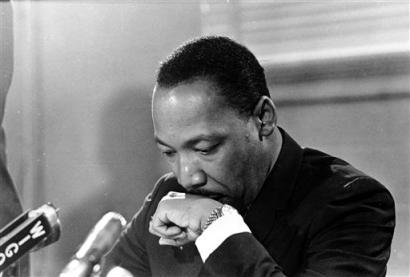
A wise man once said....
The truth of these words is beyond doubt, but the mission to which they call us is a most difficult one.
Even when pressed by the demands of inner truth, men do not easily assume the task of opposing their government's policy, especially in time of war.
Nor does the human spirit move without great difficulty against all the apathy of conformist thought within one's own bosom and in the surrounding world.
Moreover, when the issues at hand seem as perplexing as they often do in the case of this dreadful conflict, we are always on the verge of being mesmerized by uncertainty.
But we must move on.
Some of us who have already begun to break the silence of the night have found that the calling to speak is often a vocation of agony, but we must speak.
We must speak with all the humility that is appropriate to our limited vision, but we must speak.
And we must rejoice as well, for surely this is the first time in our nation's history that a significant number of its religious leaders have chosen to move beyond the prophesying of smooth patriotism to the high grounds of a firm dissent based upon the mandates of conscience and the reading of history.
Perhaps a new spirit is rising among us.
If it is, let us trace its movement, and pray that our own inner being may be sensitive to its guidance.
For we are deeply in need of a new way beyond the darkness that seems so close around us.
... A true revolution of values will soon look uneasily on the glaring contrast of poverty and wealth. With righteous indignation, it will look across the seas and see individual capitalists of the West investing huge sums of money in Asia, Africa and South America, only to take the profits out with no concern for the social betterment of the countries, and say: "This is not just." It will look at our alliance with the landed gentry of Latin America and say: "This is not just." The Western arrogance of feeling that it has everything to teach others and nothing to learn from them is not just. A true revolution of values will lay hands on the world order and say of war: "This way of settling differences is not just." This business of burning human beings with napalm, of filling our nation's homes with orphans and widows, of injecting poisonous drugs of hate into veins of people normally humane, of sending men home from dark and bloody battlefields physically handicapped and psychologically deranged, cannot be reconciled with wisdom, justice and love. A nation that continues year after year to spend more money on military defense than on programs of social uplift is approaching spiritual death.America, the richest and most powerful nation in the world, can well lead the way in this revolution of values. There is nothing, except a tragic death wish, to prevent us from reordering our priorities, so that the pursuit of peace will take precedence over the pursuit of war.
—Excerpted from Speech delivered by Dr. Martin Luther King, Jr., on April 4, 1967, at a meeting of Clergy and Laity Concerned at Riverside Church in New York City.
A really difficult speech to excerpt. The parallels to that time and today are too numerous. Substitute Iraq for Vietnam anywhere, or terrorism for Communism, and it reads like it was written this year. It's MLK Day. We should all be required to read the whole thing...
Saturday, January 14, 2006
Happy anniversary
"I've told the American people before that this will not be another Vietnam, and I repeat this here tonight.... I'm hopeful that this fighting will not go on for long and that casualties will be held to an absolute minimum. This is an historic moment. We have in this past year made great progress in ending the long era of conflict and cold war. We have before us the opportunity to forge for ourselves and for future generations a new world order..."
Jacobs takes a long hard look at the state of the union after fifteen years of the New World Order. Ain't pretty.
The quick (and upon further thought, the most accurate) appraisal of the last fifteen years is simple. The US is wasting its resources on a war that benefits very few of its own citizens and not too many other people in the world either.
... The bad news is that they aren't finished. Most of the folks who run this country, no matter which major party they claim to belong to, think that they can win their various wars and start new ones, continue to privatize the government for the benefit of their friends (Social Security is next, mark my words), spy on and jail people at will, and then tell us that they're doing it for our own good. One party might wave a stick while the other holds a carrot in front of our nose, but the brutal reality is that both are riding the same horse into the ground--and that horse is this country we live in.
Wednesday, January 11, 2006
Gruesome arithmetic
Tom Englehardt gives credit to Seymour Hersh for bringing America's savage air war in Iraq to widespread public attention with his New Yorker article in December, but Englehardt deserves credit himself for being one of the first to call attention to it fifteen months earlier and then in even greater detail in December 2004. That December article led me to The History of Bombing, which is still one of the best context-setting books for this horrific war.
As Englehardt himself points out, it's really quite shocking that American reporters in Iraq have basically refused to "look up, or even to acknowledge the planes, predator drones, and low-flying helicopters passing daily overhead." But that's the way it's been. So props to Sy Hersh and Englehardt for calling attention to this appalling blindness on the part of our press.
Today, on the tomdispatch site, Michael Schwartz takes a look at the de facto rules of engagement in Iraq today:
that the war should be conducted to absolutely minimize the risk to American troops; that guerrilla fighters should not be allowed to escape if there is any way to capture or kill them; and that Iraqi civilians should not be allowed to harbor or encourage the resistance fighters....Schwartz concludes his piece by inviting us to ponder "this gruesome arithmetic":As one American officer explained to New York Times reporter Dexter Filkins, the willingness to sacrifice local civilians is part of a larger strategy in which U.S. military power is used to "punish not only the guerrillas, but also make clear to ordinary Iraqis the cost of not cooperating." A Marine calling in to a radio talk show recently stated the argument more precisely: "You know why those people get killed? It's because they're letting insurgents hide in their house."
This is, by the way, the textbook definition of terrorism – attacking a civilian population to get it to withdraw support from the enemy. What this strategic orientation, applied wherever American troops fight the Iraqi resistance, represents is an embrace of terrorism as a principle tactic for subduing Iraq's insurgency.
If the U.S. fulfills its expectation of surpassing 150 air attacks per month, and if the average air strike produces the (gruesomely) modest total of 10 fatalities, air power alone could kill well over 20,000 Iraqi civilians in 2006. Add the ongoing (but reduced) mortality due to other military causes on all sides, and the 1,000 civilian deaths per week rate recorded by the Hopkins study could be dwarfed in the coming year.It's lately become clear that the original estimated cost of the war is off by several orders of magnitude. I'm betting in months to come our media will be shocked—shocked!—to learn that they'll need to add a zero or two to the human cost estimates as well.The new American strategy, billed as a way to de-escalate the war, is actually a formula for the slaughter of Iraqi civilians.
Sunday, January 08, 2006
Man of Peace
As a bizarre, unpleasant controversy rages over Sharon's treatment ("Some Israeli doctors are saying anyone else in Mr Sharon's condition would have been allowed to die peacefully last Wednesday night"), a heart-rending, appalling must-read excerpt from Robert Fisk's The Great War for Civilisation: The Conquest of the Middle East puts Sharon's career into perspective (note the cameo by Rummy—war criminals always looking out for each other):
I shook hands with him once, a brisk, no-nonsense soldier's grip from Sharon as he finished a review of the vicious Phalangist militiamen who stood in the barracks square at Karantina in Beirut. Who would have thought, I asked myself then, that this same bunch of murderers - the men who butchered their way through the Palestinian Sabra and Chatila refugee camps only a few weeks earlier - had their origins in the Nazi Olympics of 1936. That's when old Pierre Gemayel - still alive and standing stiffly to attention for Sharon - watched the "order" of Nazi Germany and proposed to bring some of this "order" to Lebanon. That's what Gemayel told me himself. Did Sharon not understand this. Of course, he must have done.
Back on 18 September that same year, Loren Jenkins of The Washington Post and Karsten Tveit of Norwegian television and I had clambered over the piled corpses of Chatila - of raped and eviscerated women and their husbands and children and brothers - and Jenkins, knowing that the Isrealis had sat around the camps for two nights watching this filth, shrieked "Sharon!" in anger and rage. He was right. Sharon it was who sent the Phalange into the camps on the night of 16 September - to hunt for "terrorists", so he claimed at the time.
The subsequent Israeli Kahan commission of enquiry into this atrocity provided absolute proof that Israeli soldiers saw the massacre taking place. The evidence of a Lieutenant Avi Grabovsky was crucial. He was an Israeli deputy tank commander and reported what he saw to his higher command. "Don't interfere," the senior officer said. Ever afterwards, Israeli embassies around the world would claim that the commission held Sharon only indirectly responsible for the massacre. It was untrue. The last page of the official Israeli report held Sharon "personally responsible". It was years later that the Israeli-trained Phalangist commander, Elie Hobeika, now working for the Syrians, agreed to turn state's evidence against Sharon - now the Israeli Prime Minister - at a Brussels court. The day after the Israeli attorney general declared Sharon's defence a "state" matter, Hobeika was killed by a massive car bomb in east Beirut. Israel denied responsibility. US Defence Secretary Donald Rumsfeld traveled to Brussels and quietly threatened to withdraw Nato headquarters from Belgium if the country maintained its laws to punish war criminals from foreign nations. Within months, George W Bush had declared Sharon "a man of peace". It was all over.
Thursday, January 05, 2006
Cost of war: only off by about three zeroes...
Jan 05, 2006 -- 11:05:10 AM EST
NEW STUDY SUGGESTS ECONOMIC COST OF IRAQ WAR MUCH LARGER THAN PREVIOUSLY RECOGNIZED
A new study by two leading academic experts suggests that the costs of the Iraq war will be substantially higher than previously reckoned. In a paper presented to this week’s Allied Social Sciences Association annual meeting in Boston MA., Harvard budget expert Linda Bilmes and Columbia University Professor and Nobel Laureate Joseph E. Stiglitz calculate that the war is likely to cost the United States a minimum of nearly one trillion dollars and potentially over $2 trillion.
The study expands on traditional budgetary estimates by including costs such as lifetime disability and health care for the over16,000 injured, one fifth of whom have serious brain or spinal injuries. It then goes on to analyze the costs to the economy, including the economic value of lives lost and the impact of factors such as higher oil prices that can be partly attributed to the conflict in Iraq. The paper also calculates the impact on the economy if a proportion of the money spent on the Iraq war were spent in other ways, including on investments in the United States
“Shortly before the war, when Administration economist Larry Lindsey suggested that the costs might range between $100 and $200 billion, Administration spokesmen quickly distanced themselves from those numbers,” points out Professor Stiglitz. “But in retrospect, it appears that Lindsey’s numbers represented a gross underestimate of the actual costs.”
The Allied Social Sciences Association meeting is attended by the nation’s leading economists and social scientists. It is sponsored jointly by the American Economic Association and the Economists for Peace and Security.
Wednesday, January 04, 2006
Bush and the Republicans
Even though the signs were there a year ago, I’ve certainly been shocked by the speed of Bush’s domestic political decline, or the intensity of the resistance he’s faced from within the GOP. By year’s end, Bush was recording defeat after defeat, and sometimes on key issues — failing to get the Patriot Act renewed; being forced by McCain to back down on torture; failing to get his White House counsel appointed to the Supreme Court; scolded by a key conservative Republican-appointed judge on the handling of the Jose Padilla case; and most recently, facing the prospect of Capitol Hill hearings, arranged by Republican judiciary committee chair Arlen Specter, into his decision to order the NSA to bypass the established legal system to conduct domestic eavesdropping. We could go on and on, with Karl Rove, various budget setbacks, Michael Brown and Katrina, and so on.
Although most of these wounds have been self-inflicted, I suspect the thoughtful Republican realists in the Senate (and in the military, intelligence services and State Department) have recognized that Iraq symbolizes Bush’s catastrophic stewardship of U.S. national interests on the global scale. Not only has the idea of projecting force into the heart of the Middle East with the aim of transforming its politics along lines desired by Washington been a disaster — even the elections the administration so proudly touts portend civil war and an entrenchment of the insurgency — the U.S. appears to have lost any prospect of securing short-term tactical advantages from its occupation (access to Iraqi oil reserves; long-term military bases from which force can be projected throughout the region). And in the process the U.S. has squandered the deterrent power of its military by showing the limits of its capacity to sustain an occupation, emboldening the likes of Iran — which, curiously enough, ends up holding the key to the U.S. exit strategy by virtue of its influence with the Shiite parties that appear to have again prevailed at the polls. And the failure of the invasion to vindicate a universally unpopular decision to invade (by either turning up weapons of mass destruction, or by producing a more, not less stable region) have accelerated the decline of U.S. leadership over its traditional allies. The whole episode has made it possible for allies to say no to Washington, and then to cluck in smug sympathy while conspicuously avoiding saying “told you so.”
Iraq, overwhelmingly unpopular abroad and increasingly so at home, stands at the center of Bush’s decline — the fact that his agenda is collapsing despite his party’s control over all the levers of government is a sure sign that the sober Republicans who may have long doubted the wisdom of Bush’s choices are now no longer remaining silent. The irony is that they appear to be more inclined than the Democrats have been to distance themselves from Bush, and to challenge him directly on matters of national security. The Democrats are still flailing about unable to take a coherent position on Iraq (with a few honorable exceptions). Listen to John Kerry and Hillary Clinton, and you hear an often incomprehensible excercise in self-congratulatory political ju-jitsu — they’re quite simply not prepared to challenge the basics, which leaves them to argue that they would have invaded Iraq, but done it “properly” — more troops, more allies, that sort of thing. Frankly, that’s the same unprincipled, politically cowardly doggerel we’ve heard from them all along, and is ultimately so indistinguishable from the administration’s own positions that it simply make the Dems sound petty and partisan. There was no way to get more allies on board for the operation for the simple reason that most of the world believed there was no good reason to invade Iraq, and they wouldn’t have followed Hillary or Kerry or even Bill into that quagmire any more readily than they followed Bush. More troops? I don’t think the U.S. has enough combat troops to sustain an occupation force much larger than the one they currently have there. And the bottom line is that the Iraqis would certainly not have been any less inclined to resist an occupation designed by a Kerry or Clinton administration than the one designed by Bush.
Saturday, December 31, 2005
A thought for the New Year
For me, it was a year that began with a continuing reevaluation of how I could have been swept along with the pro-war, or at least war-tolerant, sentiment of 2002 and 2003. I still feel a sense of great shame for not resisting the post-911 bloodlust (something I've come to think was more manipulated than inherent in "the American people," but our responsibility nonetheless).
In 2004 and 2005, I did a lot of reading, and my attitude towards war changed with my disappearing ignorance about its means and motivations. I'm a grown, educated man, and had no excuse for that ignorance. Books like Andrew Bacevich's The New American Militarism, Chalmers Johnson's The Sorrows of Empire, and Sven Lindqvist's A History of Bombing, Wendell Berry's Citizenship Papers, and Zinn's People's History of the United States are available in many public libraries, and in many bookstores. They should be required reading in high schools and colleges.
With the possible exception of Berry's "Thoughts in the presence of fear,"I can't think of a single essay that better expresses what our attitude should be towards war than this one by Howard Zinn, published in the January 2006 Progressive. Initially I resisted the optimism, but then thought, hell, what better time to think about shooting the moon than at the beginning of a New Year.
Happy New Year.After the War
The war against Iraq, the assault on its people, the occupation of its cities, will come to an end, sooner or later. The process has already begun. The first signs of mutiny are appearing in Congress. The first editorials calling for withdrawal from Iraq are beginning to appear in the press. The anti-war movement has been growing, slowly but persistently, all over the country.
Public opinion polls now show the country decisively against the war and the Bush Administration. The harsh realities have become visible. The troops will have to come home.
And while we work with increased determination to make this happen, should we not think beyond this war? Should we begin to think, even before this shameful war is over, about ending our addiction to massive violence and instead using the enormous wealth of our country for human needs? That is, should we begin to speak about ending war—not just this war or that war, but war itself? Perhaps the time has come to bring an end to war, and turn the human race onto a path of health and healing.
A group of internationally known figures, celebrated both for their talent and their dedication to human rights (Gino Strada, Paul Farmer, Kurt Vonnegut, Nadine Gordimer, Eduardo Galeano, and others), will soon launch a worldwide campaign to enlist tens of millions of people in a movement for the renunciation of war, hoping to reach the point where governments, facing popular resistance, will find it difficult or impossible to wage war.
There is a persistent argument against such a possibility, which I have heard from people on all parts of the political spectrum: We will never do away with war because it comes out of human nature. The most compelling counter to that claim is in history: We don’t find people spontaneously rushing to make war on others. What we find, rather, is that governments must make the most strenuous efforts to mobilize populations for war. They must entice soldiers with promises of money, education, must hold out to young people whose chances in life look very poor that here is an opportunity to attain respect and status. And if those enticements don’t work, governments must use coercion: They must conscript young people, force them into military service, threaten them with prison if they do not comply.
Furthermore, the government must persuade young people and their families that though the soldier may die, though he or she may lose arms or legs, or become blind, that it is all for a noble cause, for God, for country.
When you look at the endless series of wars of this century you do not find a public demanding war, but rather resisting it, until citizens are bombarded with exhortations that appeal, not to a killer instinct, but to a desire to do good, to spread democracy or liberty or overthrow a tyrant.
Woodrow Wilson found a citizenry so reluctant to enter the First World War that he had to pummel the nation with propaganda and imprison dissenters in order to get the country to join the butchery going on in Europe.
In the Second World War, there was indeed a strong moral imperative, which still resonates among most people in this country and which maintains the reputation of World War II as “the good war.” There was a need to defeat the monstrosity of fascism. It was that belief that drove me to enlist in the Air Force and fly bombing missions over Europe.
Only after the war did I begin to question the purity of the moral crusade. Dropping bombs from five miles high, I had seen no human beings, heard no screams, seen no children dismembered. But now I had to think about Hiroshima and Nagasaki, and the firebombings of Tokyo and Dresden, the deaths of 600,000 civilians in Japan, and a similar number in Germany.
I came to a conclusion about the psychology of myself and other warriors: Once we decided, at the start, that our side was the good side and the other side was evil, once we had made that simple and simplistic calculation, we did not have to think anymore. Then we could commit unspeakable crimes and it was all right.
I began to think about the motives of the Western powers and Stalinist Russia and wondered if they cared as much about fascism as about retaining their own empires, their own power, and if that was why they had military priorities higher than bombing the rail lines leading to Auschwitz. Six million Jews were killed in the death camps (allowed to be killed?). Only 60,000 were saved by the war—1 percent.
A gunner on another crew, a reader of history with whom I had become friends, said to me one day: “You know this is an imperialist war. The fascists are evil. But our side is not much better.” I could not accept his statement at the time, but it stuck with me.
War, I decided, creates, insidiously, a common morality for all sides. It poisons everyone who is engaged in it, however different they are in many ways, turns them into killers and torturers, as we are seeing now. It pretends to be concerned with toppling tyrants, and may in fact do so, but the people it kills are the victims of the tyrants. It appears to cleanse the world of evil, but that does not last, because its very nature spawns more evil. Wars, like violence in general, I concluded, is a drug. It gives a quick high, the thrill of victory, but that wears off and then comes despair.
I acknowledge the possibility of humanitarian intervention to prevent atrocities, as in Rwanda. But war, defined as the indiscriminate killing of large numbers of people, must be resisted.
Whatever can be said about World War II, understanding its complexity, the situations that followed—Korea, Vietnam—were so far from the kind of threat that Germany and Japan had posed to the world that those wars could be justified only by drawing on the glow of “the good war.” A hysteria about communism led to McCarthyism at home and military interventions in Asia and Latin America—overt and covert—justified by a “Soviet threat” that was exaggerated just enough to mobilize the people for war.
Vietnam, however, proved to be a sobering experience, in which the American public, over a period of several years, began to see through the lies that had been told to justify all that bloodshed. The United States was forced to withdraw from Vietnam, and the world didn’t come to an end. One half of one tiny country in Southeast Asia was now joined to its communist other half, and 58,000 American lives and millions of Vietnamese lives had been expended to prevent that. A majority of Americans had come to oppose that war, which had provoked the largest anti-war movement in the nation’s history.
The war in Vietnam ended with a public fed up with war. I believe that the American people, once the fog of propaganda had dissipated, had come back to a more natural state. Public opinion polls showed that people in the United States were opposed to send troops anywhere in the world, for any reason.
The Establishment was alarmed. The government set out deliberately to overcome what it called “the Vietnam syndrome.” Opposition to military interventions abroad was a sickness, to be cured. And so they would wean the American public away from its unhealthy attitude, by tighter control of information, by avoiding a draft, and by engaging in short, swift wars over weak opponents (Grenada, Panama, Iraq), which didn’t give the public time to develop an anti-war movement.
I would argue that the end of the Vietnam War enabled the people of the United States to shake the “war syndrome,” a disease not natural to the human body. But they could be infected once again, and September 11 gave the government that opportunity. Terrorism became the justification for war, but war is itself terrorism, breeding rage and hate, as we are seeing now.
The war in Iraq has revealed the hypocrisy of the “war on terrorism.” And the government of the United States, indeed governments everywhere, are becoming exposed as untrustworthy: that is, not to be entrusted with the safety of human beings, or the safety of the planet, or the guarding of its air, its water, its natural wealth, or the curing of poverty and disease, or coping with the alarming growth of natural disasters that plague so many of the six billion people on Earth.
I don’t believe that our government will be able to do once more what it did after Vietnam—prepare the population for still another plunge into violence and dishonor. It seems to me that when the war in Iraq ends, and the war syndrome heals, that there will be a great opportunity to make that healing permanent.
My hope is that the memory of death and disgrace will be so intense that the people of the United States will be able to listen to a message that the rest of the world, sobered by wars without end, can also understand: that war itself is the enemy of the human race.
Governments will resist this message. But their power is dependent on the obedience of the citizenry. When that is withdrawn, governments are helpless. We have seen this again and again in history.
The abolition of war has become not only desirable but absolutely necessary if the planet is to be saved. It is an idea whose time has come.
Wednesday, December 28, 2005
The I word? What about the D word?
Jonathan Schell's "The Hidden State Steps Forward" makes a very convincing case that W., with his stunningly brazen defense of his wiretapping offense, has basically declared himself dictator:
When the New York Times revealed that George W. Bush had ordered the National Security Agency to wiretap the foreign calls of American citizens without seeking court permission, as is indisputably required by the Foreign Intelligence Surveillance Act (FISA), passed by Congress in 1978, he faced a decision. Would he deny the practice, or would he admit it? He admitted it. But instead of expressing regret, he took full ownership of the deed, stating that his order had been entirely justified, that he had in fact renewed it thirty times, that he would continue to renew it and--going even more boldly on the offensive--that those who had made his law-breaking known had committed a "shameful act." As justification, he offered two arguments, one derisory, the other deeply alarming. The derisory one was that Congress, by authorizing him to use force after September 11, had authorized him to suspend FISA, although that law is unmentioned in the resolution. Thus has Bush informed the members of a supposedly co-equal branch of government of what, unbeknownst to themselves, they were thinking when they cast their vote. The alarming argument is that as Commander in Chief he possesses "inherent" authority to suspend laws in wartime. But if he can suspend FISA at his whim and in secret, then what law can he not suspend? What need is there, for example, to pass or not pass the Patriot Act if any or all of its provisions can be secretly exceeded by the President?
Bush's choice marks a watershed in the evolution of his Administration. Previously when it was caught engaging in disgraceful, illegal or merely mistaken or incompetent behavior, he would simply deny it. "We have found the weapons of mass destruction!" "We do not torture!" However, further developments in the torture matter revealed a shift. Even as he denied the existence of torture, he and his officials began to defend his right to order it. His Attorney General, Alberto Gonzales, refused at his confirmation hearings to state that the torture called waterboarding, in which someone is brought to the edge of drowning, was prohibited. Then when Senator John McCain sponsored a bill prohibiting cruel, inhuman and degrading treatment of prisoners, Bush threatened to veto the legislation to which it was attached. It was only in the face of majority votes in both houses against such treatment that he retreated from his claim.
But in the wiretapping matter, he has so far exhibited no such vacillation. Secret law-breaking has been supplanted by brazen law-breaking. The difference is critical. If abuses of power are kept secret, there is still the possibility that, when exposed, they will be stopped. But if they are exposed and still permitted to continue, then every remedy has failed, and the abuse is permanently ratified. In this case, what will be ratified is a presidency that has risen above the law.
The danger is not abstract or merely symbolic. Bush's abuses of presidential power are the most extensive in American history. He has launched an aggressive war ("war of choice," in today's euphemism) on false grounds. He has presided over a system of torture and sought to legitimize it by specious definitions of the word. He has asserted a wholesale right to lock up American citizens and others indefinitely without any legal showing or the right to see a lawyer or anyone else. He has kidnapped people in foreign countries and sent them to other countries, where they were tortured. In rationalizing these and other acts, his officials have laid claim to the unlimited, uncheckable and unreviewable powers he has asserted in the wiretapping case. He has tried to drop a thick shroud of secrecy over these and other actions.
There is a name for a system of government that wages aggressive war, deceives its citizens, violates their rights, abuses power and breaks the law, rejects judicial and legislative checks on itself, claims power without limit, tortures prisoners and acts in secret. It is dictatorship.
Wednesday, December 21, 2005
Operation Screw This
In a striking rebuke of the assertions of the Pentagon and the White House that a swift exit is neither practical nor possible, soldiers of varying rank have outlined a straightforward plan of immediate disengagement, dubbed "Operation Screw This."
"We kicked around several withdrawal scenarios in our barracks, but ultimately settled on the idea of getting out of here as soon as possible," said Maj. Brian Garcia, who is on his third tour of duty in Iraq.
Supporters of the Iraq war say the reconstruction of politically and economically devastated Iraq will take decades, and the gradual process of departure will begin only after a lengthy occupation.
"I'm familiar with the 'years of occupation to facilitate reconstruction' theory," said Army Spc. Megan Beaulieu. "However, virtually every soldier I know—including myself—gives more credence to the successful Dutch and Spanish approach of 'we've done all we can here, let's move out.'"
She added: "Apache helicopters could rendezvous with us in Fallujah. If we left our supplies behind, we could be out of here in 15 minutes."
Rant extraordinaire...
My good friend Ron of losfuzzydice.com rants quite beautifully on this point, and I hope he doesn't mind if I quote him at length:
we're not at war. repeat it. we're not at war. write it down. send it to your friends and enemies. we're not a nation at war. there is no war.
I am so tired of hearing the president and his flying monkeys repeat this ad naseum as if it's supposed to convince us that we must fight with them or be defeatists. the only thing I know I'm fighting for sure is tooth decay with minty fresh Colgate toothpaste and even that is only partially effective.
we may be at odds with a particular ideology, but what else is new. we may be at odds against terrorism just like we are at odds against poverty, illiteracy, and racism. but we are not at war against those things. people are not shooting other people over illiteracy. though people do get shot by racists and poor people do tend to get shot more by the police. because it's not a fuckin' "real" war.
we may be victims of sexism, homophobia, age-ism, and child abuse. but we are not at war against those things, except purely in a metaphorical sense. I will stand here at tell you that those issues might well be with us for a long time -- maybe even forever -- but it's not like you can find one person, kill him or her, and children will never be abused again. it doesn't work like that. There are no captains of racism nor playing cards with pictures of those who won't give women a raise -- and even if there were, it wouldn't make a difference because it's not a fuckin' war. and if you think there should be, guess what, you're a fuckin' idiot and you're part of the problem. there is no war.
we are not at war against people who use drugs, but drug addicts are battling against their own demons. you can drop bombs on all the illegal drug factories in the world, shoot down every pot smoker you see (or worse -- send them to Gitmo and torture them by flushing copies of Zap comics down the toilet) and you know what -- whatever it is that makes people take those drugs (and let's say most people I know are drug addicts -- whether it's heroin or prozac -- some people can afford to get a presciption and others get rid of the middle man) will continue to do so whether its a rotten childhood, chemical imbalance, or just because it's fun and feels good. because it's not a "real" war.
there have always been terrorists, just like there have always been greedy fucks who force other people to work for shitty wages and in dangerous conditions whilst they count their drachmas and drink their grog. and if you don't believe me, watch any version of Zorro or Robin Hood.
there is not war against terrorists, just like there is no war against greed, sloth, vanity or any of the other seven deadly sins. it's called the human condition. but maybe bush and his courtesans were absent that day in school. and if you think you can win such a war, you're a fuckin' idiot, because it's not a fuckin' war.
you want to fight against something? go fight against the ravages of time and get a fuckin' facelift. otherwise, get over it and sit the fuck down, there's no war. we're not at war. get it? no war.
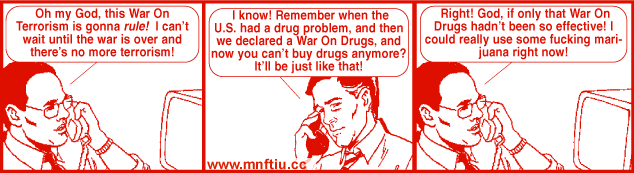
Reminds me of this classic from get your war on:
Tuesday, December 20, 2005
I'm not worthy...
Far be it from me to ask the government to take money it needs to wage war and enrich the arms industry to track down yet one more peace activist. Therefore, I consider it my civic duty to say, "Here I am, George. Come and get me." No need to squander cash that could be spent on refining the techniques of torture on costly surveillance projects and electronic wiretaps to track the likes of me.
That overweight middle-aged woman in bifocals standing on the street corner and marching in demonstrations would be me.
Age 48, married, mother of four, high school religion teacher, Catholic, garden-variety activist.
Yes, George, I was the one standing outside the doors of recruitment stations quoting Oscar Romero, who said, "God’s law must prevail. No soldier is obliged to obey an order contrary to the law of God." Not terribly original, I know, but that great cloud of witnesses that goads me on to do this work included people who were so much more articulate than I. At one recruitment center, I even quoted Pope John Paul II who told young people: "Do not listen to voices which speak the language of hatred, revenge, retaliation. Do not follow any leaders who train you in the way of inflicting death."
Monday, December 19, 2005
... but who's counting?
It prompted Andrew Cockburn to revisit the issue of the counting of the dead and to bring up that huge elephant in the corner of the room—the fact that the Lancet study, by far the most reliable study to date, puts the number of "excess deaths" in Iraq since the U.S. invasion much much higher.
The Lancet study, released in Oct. 2004, still stands as the best and bravest attempt to get at the true human cost of this disgusting venture. See here for reasons.
When that study is mentioned at all, the 100,000 excess deaths it posits is cited as the highest conceivable tally. Even liberal Boston Globe columnist Derrick Z. Jackson says 100,000 is "the most controversial estimate."
But that tally of 100,000 deaths was as of autumn 2004, and is skewed by the fact that the Lancet authors made a point, somewhat arbitrarily, of excluding Fallujah, the hottest of all hot spots from the counting.
Writes Cockburn: "Columbia professor Richard Garfield, one of the [Lancet] team members and study authors, told me this week that by now the number of 'excess deaths' in Iraq 'couldn't possibly be less than 150,000.' But, he added, 'there's no reason to be guessing. We ought to know better.'"
Friday, December 16, 2005
Rock on, Russ
"I don't want to hear again from the attorney general or anyone on this floor that this government has shown it can be trusted to use the power we give it with restraint and care."—Russ Feingold
Thursday, December 15, 2005
A stupid question pondered, unstoned
Kinsley rightly lumps in the ticking time bomb terrorist who must be tortured to save hundreds/thousands/millions/all humanity in with other questions that "have been pondered and disputed since the invention of the college dorm, but rarely, until the past couple of weeks, unstoned."
But he does get around to the main point, and makes it well.
Of course a million deaths is hard to shrug off as a price worth paying for the principle that we don't torture people. But college dorm what-ifs like this one share a flaw: They posit certainty (about what you know and what will happen if you do this or that). And uncertainty is not only much more common in real life: It is the generally unspoken assumption behind civil liberties, rules of criminal procedure, and much else that conservatives find sentimental and irritating.
... Sure, if we could know the present and predict the future with certainty, we could torture only people who deserve it. Not just that: We could go door-to-door killing people before they kill others.
Wednesday, December 14, 2005
My kind of Christmas carol...
'Tis this season of joy and merrymaking, marred only by the "war on Christmas", as stupid a non-issue today as it was in 1959, when it was a pet issue of the John Birch Society.
What is UP with these idiots? Bill O'Reilly, John Gibson, Jerry Falwell and the other genius right-wingers who are boycotting Wal-Mart (!?!?)?? The mind boggles truly.
As Nina Burleigh put it so nicely in Huffingtonpost the other day," 21st Century Christians living in the United States, arguably among the best-protected believers on earth right now, [but] still feel that they are inches away from the lion's den."
Er, back to "Fairytale of New York." As a corrective to all this rancor over the holiday season, I frequently give that bittersweet, but mostly bitter, fable a spin. To the Falwells and O'Reilly's of the world, I frequently feel the apropos response is contained in that song's chorus, the immortal words:
Happy Christmas your arseAnd while we're on the subject of dubious religious mythography, I share this inspired piece of satire by Jerry and Joe Long, from Huffingtonpost.com.
I pray God it's your last...
BRIAN: Talking with Paul Of Tarsus...author of “The Collected Letters of Paul Of Tarsus”. First of all, you refer to yourself as being “Of” Tarsus...so you are from Tarsus?
PAUL: Yes.
BRIAN: And you’re an actual human being?
PAUL: Yes.
BRIAN: You’re not a composite?
PAUL: No.
BRIAN: Some of these religious authors are composites of fragments of writing accumulated over centuries...did you know that?
PAUL: Yes I did.
BRIAN: What are your letters about?
PAUL: God.
BRIAN: Which god?
PAUL: The true God.
BRIAN: Which true god?
PAUL: Jesus...the Son of the true God.
BRIAN: Some people feel this Jesus was a reforming Jewish rabbi.
PAUL: They’re wrong.
BRIAN: What god is this Jesus the son of?
PAUL: Yaweh.
BRIAN: The Jewish god?
PAUL: Yes.
BRIAN: Why would the Jewish god suddenly have an interest in what are known as “gentiles”?
PAUL: He just does.
BRIAN: But...in the Jewish books..their god is petty, insecure, vindictive, bloodthirsty and intolerant.
PAUL: That’s right.
BRIAN: Yet in your letters...the same god is all loving, all caring and all forgiving...what happened to him?
PAUL: Uhh...he is who was... and will be.
BRIAN: So this is one of those “faith” things then?
PAUL: Yes.
BRIAN: Your Jesus is the son of god?
PAUL: Yes.
BRIAN: Did he ever make that claim for himself?
PAUL: Not as strongly as I am making it.
BRIAN: Were you a close friend of Jesus when he was alive?
PAUL No.
BRIAN: Friend?
PAUL: No.
BRIAN: Acquaintance?
PAUL: No.
BRIAN: Hang out together once in awhile?
PAUL: No.
BRIAN: Ever meet him at all?
PAUL: No.
BRIAN: So this is an unauthorized biography then?
PAUL: No.
BRIAN: Well how are you qualified to speak for this Jesus?
PAUL: I used to persecute his followers.....
BRIAN: What are your long range plans? Any future scrolls in the works?
PAUL: Well, as I say in the letters, the world is going to end shortly... so there wouldn’t really be much point.
BRIAN: The world’s going to end?
PAUL: Yes.
BRIAN: Now, did you write that to sell scrolls or do you really believe it?
PAUL: I believe it.
BRIAN: Is it going to end soon?
PAUL: We are living in the final days.
BRIAN: You’re sure?
PAUL: Oh yes! Many alive today will witness the end of the world.
This is as absolutely and undeniably true as anything else
I have written.
BRIAN: Paul Of Tarsus, thank you.
(Paul was executed in 64 A.D.. A few years later, the Emperor Galba, grown weary of Brian of Lamb’s persistently reasoned questioning, had him sown alive inside animal skins and thrown to a pack of wolves. The world is still here.)
Air can hurt you too
It's shocking how little is revealed by the U.S. military about what they're doing up there, and how little is demanded by mainstream reporters about the kinds of munitions being dropped everyday on Iraqis' heads.
Plus, I don't think anyone is making the case strongly enough that precision air strikes are a bunch of bullshit. Sometimes "smart" air attacks come off as planned (but what's the margin of error? Nobody's saying), sometimes they don't.
But I'm thinking the U.S. is using more "dumb" bombs than they're letting on, and I think journalists should be asking more pointed questions, not because they think their questions will get honest answers, but as a minimal show of spine, maybe a little self-respect.
I'm thinking for some reason about that great (but cryptic) Talking Heads song Air.
Where is that protection that I needed?
Air can hurt you too
Air can hurt you too
Some people say not to worry about the air
Some people don't know shit about the...
Air...
Tuesday, December 13, 2005
Agroterrorism: How Could You Tell?
Writing for Common Dreams, Stan Cox, a Kansas-based plant breeder and writer, has a witty and awfully sad take on the specter of "agro-terrorism."
First, he gets a big "thank you" for calling attention to the absurdly random semantics of the terror threat naming racket. The bottom line: watch out for prefixes:
The meat of his argument, however, is in a point-by-point look at the variety of agroterrorist threats, as described so breathlessly by Republican senators Susan Collins and Pat Roberts.Keeping in mind that terrorists never seem inclined to take targeting suggestions from US politicians, we know these days to treat any use the word "terrorism" with deep skepticism. But when a prefix is attached, we should be especially wary.
Given the lack of standardization (the prefix of "bioterrorism" denoting the means of attack, of "narcoterrorism" the means of finance, of "ecoterrorism" the beneficiary, and of "agroterrorism" the target) it's clear that "terrorism" is simply a device to draw attention to whatever is in the prefix, and maybe scare up some funding.
Contaminating the food supply? Who would know, with 76 million Americans getting sick each year from foodborne illness? Poisoning the rural water supply? Already got that goin' on pretty well, too, thanks. Chemical weapons? Let's look at the consequences of the 1.2 billion POUNDS of pesticides used in the U.S. each year.
Cox concludes:
Those who are sounding the agroterrorism alarm acknowledge that the increasing concentration of US agriculture, and its increasingly industrial infrastructure, make it more vulnerable. But those same, homegrown forces are already having consequences that are not easy to distinguish from the results of a hypothetical agroterror attack.
With an agriculture like this, who needs terrorists?
Wednesday, December 07, 2005
Lieberman Lieberman
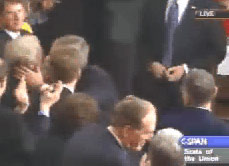
Lieberman, shown above with Dubya's tongue down his throat, is calling for formation of a "War Cabinet," to be called the "Bipartisan Victory in Iraq Administrative Group."
And Dick Cheney would have kissed him if he could: "He is entirely correct. On this, both Republicans and Democrats should be able to agree. The only way the terrorists can win is if we lose our nerve and abandon our mission."
Um. And that mission was to ... ?
Earth to Lieberman: A Quinnipiac University poll released Tuesday said 60 percent favor withdrawing from Iraq. And a leaked British military poll says a full 80 percent of Iraqis want the U.S. and coalition troops gone.
Hey, but it's only their country.

