Thursday, June 08, 2006

That trillion bucks is beginning to look like money well spent. Yeah boy!

What precision!

Let's just say a little skepticism is merited.

I really have no idea what exactly to believe about this Zarqawi character. And I am certain I will never know a whole lot more than I know now. He was something of a lunatic, by all accounts.

It's a bit of an understatement, but I'll say it: it seemed veerrrry convenient for the Pentagon to make him into something of a terrorist superhero with almost mystical powers. As Chris Floyd put it, he was a "notorious shape-shifter who, according to grainy video evidence, was able to regenerate lost limbs, speak in completely different accents, alter the contours of his bone structure and also suffered an unfortunate binge-and-purge weight problem which caused him to change sizes with almost every appearance."

Billmon has a pretty hilarious take on this:

Over the next few weeks, insiders say, Pentagon Channel executives determined that while the Zarqawi show still had a dedicated following of hardcore fans who would swallow any plot device, no matter how ludicrous, the series no longer made commercial or artistic sense. It was also believed that a spectacular and upbeat finale might lure viewers away from Haditha, the controversial docudrama now airing on the rival Reality Network.

Network sources say the Pentagon Channel is weighing a possible sequel to the Abu Zarqawi Hour, featuring an identical plot but a completely different cast. The network and Zarqawi have permanently severed their relationship, these sources added, due to "irreconcilable creative differences."

Pentagon Channel officials declined to respond to questions about a possible sequel, saying only that "all options are under consideration. Things related and not."

Mr. Zarqawi was unavailable for comment.

Bottom line is this: Score another one for extrajudicial murder. It sure got Alan Dershowitz all hot. But what about the father of the man beheaded by Zarqawi? Is he jumping up and down?
Well, you know, I'm not saying Saddam Hussein was a good man, but he's no worse than George Bush. Saddam Hussein didn't pull the trigger, didn't commit the rapes. Neither did George Bush, but both men are responsible for them under their reigns of terror. I don't buy that.

Iraq did not have al Qaeda in it. Al Qaeda supposedly killed my son. Under Saddam Hussein, no al Qaeda. Under George Bush, al Qaeda. Under Saddam Hussein, relative stability. Under George Bush, instability. Under Saddam Hussein, about 30,000 deaths a year. Under George Bush, about 60,000 deaths a year.

I don't get it. Why is it better to have George Bush be the king of Iraq rather than Saddam Hussein?


Friday, May 26, 2006

Presidential timber?


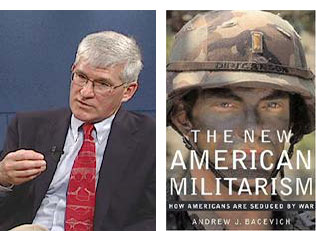
I say this only half in jest. Andrew Bacevich for president!

This guy is a straight arrow, West Point grad, Vietnam War vet, who left the military to get his Ph.D. from Princeton, and now teaches at B.U.

Until fairly recently a National Review contributor, he (along with James Carroll, who literally grew up in the Pentagon) is one of the few military industrial complex insiders who has been able to see what an abominable war machine America has created. He's especially good on America's "shortsighted infatuation with military power," and the (mostly sinister) ways the military has changed in recent years. And he, like Carroll, has come around to the full horror of our nation's blind acceptance of strategic bombing and nuclear weapons.

This week Bacevich has been speaking to Tom Engelhardt, who has recently featured a terrific series of interviews with the likes of Mike Davis, Katrina vanden Heuvel and Chamlers Johnson. Here are a few excerpts from his chat with Bacevich.

In any case, the Cold War essentially ends in 1989 when the [Berlin] Wall goes down; in '91, the Soviet Union collapses. I get out of the Army in 1992 and I'm waiting with bated breath to see what impact the end of the Cold War is going to have on U.S. policy, particularly military policy. The answer is, essentially, none. We come out even more firmly committed to the notion of U.S. military global supremacy. Not because there was an enemy -- in 1992, ‘93, ‘94, there's no enemy -- but because we've come to see military supremacy and global hegemony as good in and of themselves.

The end of the Cold War sees us using military power more frequently, while our ambitions, our sense of what we're supposed to do in the world, become more grandiose. There's all this bloated talk about "the end of history," and the "right side of history," and the "indispensable nation," politicians and pundits pretending to know the destiny of humankind. So I began to question my understanding of what had determined U.S. behavior during the Cold War. The orthodox narrative said that the U.S. behaved as it did because of them, because of external threats. I came to believe that explanation was not entirely wrong but limited. You get closer to the truth by recognizing that what makes us behave the way we behave comes from inside. I came to buy into the views of historians like Charles Beard and William Appleton Williams who emphasize that foreign policy is an outgrowth of domestic policy, in particular of the structure of the American political economy.

So I became a critic of U.S. foreign policy in the 1990s, a pretty outspoken one.

TD: You wrote a book then with the word "empire" in the title...

Bacevich: Yes, because I became convinced that what we saw in the 90s from both Democrats and Republicans was an effort to expand an informal American empire. Fast forward to 9/11 and its aftermath, and the Bush doctrine of preventive war as implemented in Iraq, and the full dimensions of our imperial ambitions become evident for all to see.

I have to say, I certainly supported the Afghanistan War. I emphatically believed that we had no choice but to take down the Taliban regime in order to demonstrate clearly the consequences of any nation tolerating, housing, supporting terrorists who attack us. But the Iraq War just struck me as so unnecessary, unjustifiable, and reckless that... I don't know how to articulate its impact except that it put me unalterably in the camp of those who had come to see American power as the problem, not the solution. And it brought me close to despair that the response of the internal opposition and of the American people generally proved to be so tepid, so ineffective. It led me to conclude that we are in deep, deep trouble.

An important manifestation of that trouble is this shortsighted infatuation with military power that goes beyond even what I wrote about in my most recent book. Again, it revolves around this question of energy and oil. There's such an unwillingness to confront the dilemmas we face as a people that I find deeply troubling. I know we're a democracy. We have elections. But it's become a procedural democracy. Our politics are not really meaningful. In a meaningful politics, you and I could argue about important differences, and out of that argument might come not resolution or reconciliation, but at least an awareness of the consequences of going your way as opposed to mine. We don't even have that argument. That's what's so dismaying.

TD: You've used the word "crusade" and spoken of this administration as "intoxicated with the mission of salvation." I was wondering what kind of "ism" you think we've been living with in these years?

Bacevich: That's a great question, and it's not enough to say that it's democratic capitalism. Certainly, our "ism" incorporates a religious dimension -- in the sense of believing that God created this nation for a purpose that has to do with universal values.

We have not as a people come to terms with our relationship to military power and to the wars we've engaged in and the ways we've engaged in them. Now, James Carroll in his new book, House of War, is very much preoccupied with strategic bombing in World War II and since, and especially with our use of, and attitude toward, nuclear weapons. His preoccupation is understandable because those are the things we can't digest and we can't cough up. You know, at the end of the day, we, the missionary nation, the crusader state, certain of our righteousness, remain the only people to have used nuclear weapons in anger -- indeed, to have used them as a weapon of terror.

TD: Air power, even though hardly covered in our media in Iraq, has been the American way of war since World War II, hasn't it?

Bacevich: Certainly that "ism" that defines us has a large technological component, doesn't it? I mean, we are the people of technology. We see the future as a technological one and can't imagine a problem that doesn't have technological solutions...

TD: ...except when it comes to oil.

Bacevich: Quite true. In many respects, the technological artifact that defines the last century is the airplane. With the airplane came a distinctive style of warfare. The Italians dropped the first bomb in North Africa; the Japanese killed their share of civilians from the air as did the Germans, but we and our British cousins outdid them all. I've been thinking more and more that our record of strategic bombing is not simply an issue of historical interest.

We are not who we believe we are and, in some sense, others perceive us more accurately than we do ourselves. The President has described a version of history -- as did Clinton, by the way -- beginning with World War II in which the United States is the liberator, Americans are the bringers of freedom. There is truth to that narrative, but it's not the whole truth; and, quite frankly, it's not the truth that matters a lick, let's say, to the Islamic world today. Muslims don't give a darn that we brought Hitler or the Third Reich to its knees. What they're aware of is all kinds of other behavior, particularly in their neck of the woods, that had nothing to do with spreading democracy and freedom, that had everything to do with power, with trying to establish relations that maximized the benefit to the United States and American society. We don't have to let our hearts bleed about that. That's the way politics works, but let's not delude ourselves either. When President George W. Bush says, "America stands for freedom and liberty, and we're coming to liberate you," it's absurd to expect people in that part of the world to take us seriously. That's not what they've seen and known and experienced in dealing with the United States.

TD: And, of course, within the councils of this administration, they threw out anyone who knew anything about the record of U.S. policy in the Islamic world.

Bacevich: Because those experts would have challenged the ideologically soaked version of history that this administration has attempted to carry over into the 21st century. Only if we begin to see ourselves more clearly, will we be able to understand how others see us. We need to revise the narrative of the American Century and recognize that it has been about a host of other things that are far more problematic than liberation. There can be no understanding the true nature of the American century without acknowledging the reality of Hiroshima, Nagasaki, Dresden, Hanoi, and Haiphong.

Wednesday, May 17, 2006

Can't make this shit up

From USA Today, Study guide for U.S. citizenship test omits freedom of press:
WASHINGTON — A set of flashcards designed to help applicants for U.S. citizenship learn basic civics has become one of the most popular items sold by the Government Printing Office.

But the $8.50 flashcards — which contain questions and answers from the actual citizenship exam — won't help immigrants learn much about the role of the press in American democracy.

Question 80 asks, "Name one right or freedom guaranteed by the First Amendment." The answer lists freedom of speech, religion, assembly and the right to petition the government — but omits freedom of the press.

Fear not: there's a $6 million redesign in the works.

What they mean by 'the people'

George Monbiot sees more than a little hypocrisy in the West's reactions to two recent nationalizations of oil fields—one by Evo Morales ("petulant," "xenophobic," and "capricious," according to the Times) and another by Idriss Deby, "our" friend in Chad (where life expectancy is 43.6 years), in partnership with Exxon and the World Bank.

Morales says he will use the revenues from Bolivia's own natural resources to help the poor of his nation. If, Monbiot writes, Morales "uses the extra revenues from Bolivia's gas fields in the same way as Hugo Chávez has used the money from Venezuela's oil, the result is likely to be a major improvement in his people's welfare." Chad's government, in contrast (which incidentally has an abysmal human rights record) will use its revenues to buy ... weapons!

So, on the one hand, you have a man who has kept his promises by regaining control over the money from the hydrocarbon industry, in order to use it to help the poor. On the other, you have a man who has broken his promises by regaining control over the money from the hydrocarbon industry, in order to buy guns. The first man is vilified as irresponsible, childish and capricious. The second man is left to get on with it. Why? Well, Deby's actions don't hurt the oil companies. Morales's do. When Blair and Rice and the Times and all the other apologists for undemocratic power say "the people," they mean the corporations. The reason they hate Morales is that when he says "the people," he means the people.

Monday, May 15, 2006

"So who is in charge of finding WMD?"


Billmon is excellent here in finding Dubya's ultimate alibi in recent revelations about the (nonexistence of) the Flaming Winnebagos of Death. I'm not sure I'm as ready as he is to let the chimp off the hook but he makes a good case.
I realize that at this point I'm kind of beating a dead horse -- or a dying administration's dead crediblity, as the case may be. But I think it's important to keep wailing away, particularly since Big Media seems perfectly content to let them do it again.

On one count, though -- whether Shrub knew at the time that his babbling lies about the Flaming Winnebagos of Death were, in fact, lies -- I actually tend to believe the White House spin. I don't think he had a single clue one way or the other, as this report in Time (from that time) indicates:

Meeting last month [i.e. June 2003) at a sweltering U.S. base outside Doha, Qatar, with his top Iraq commanders, President Bush skipped quickly past the niceties and went straight to his chief political obsession: Where are the weapons of mass destruction?

Turning to his Baghdad proconsul, Paul Bremer, Bush asked, "Are you in charge of finding WMD?" Bremer said no, he was not.

Bush then put the same question to his military commander, General Tommy Franks. But Franks said it wasn't his job either.

A little exasperated, Bush asked, So who is in charge of finding WMD? After aides conferred for a moment, someone volunteered the name of Stephen Cambone, a little-known deputy to Donald Rumsfeld, back in Washington. Pause.

"Who?" Bush asked.

Pretty pathetic, no?

That "little known" deputy, by the way, was the Undersecretary of Defense for Intelligence -- a post dreamed up by Rumsfeld and his congressional enablers, and designed to be one of the most powerful jobs, if not the most powerful job, in the U.S. intelligence community. At this point, Cambone -- who is so hated inside the Pentagon a general once told Army Times that "if I had one bullet left in my revolver, I'd take out Cambone" -- is a considerably bigger cog in the secret government than Bush will ever be.

Maybe that's why the president of the United States had never heard the name: Like the classified report on the non-existent bioweapons labs, Cambone's role in the WMD snipe hunt was on a need-to-know basis -- and Shrub didn't need to know.

But while Commander Codpiece may have been as clueless as ever, and nobody seems to have told Powell anything, except what time to show up for his next photo op, is anybody seriously going to argue that Rumsfeld, Rice and Cheney didn't know they were spreading deliberate falsehoods? Cheney? The guy so obsessed with the details of the WMD fraud that he found time to scribble little notes to self ("Remember to ratfuck Joe Wilson") in the margins of New York Times clippings?

If the House Dems are serious about fishing for impeachable offenses (assuming they get control of the fishing rod this November) they could pick a worse place to start -- for Cheney, Rice and Rumsfeld, I mean. For Shrub, though, I think they're going to have look elsewhere. The problem is that in the end, no matter where they look, they're probably going to run up against the Nuremberg defense -- he was only following orders.

Read the whole piece...

Friday, May 12, 2006

Dumping the dollar

This was coming for some time, I guess:
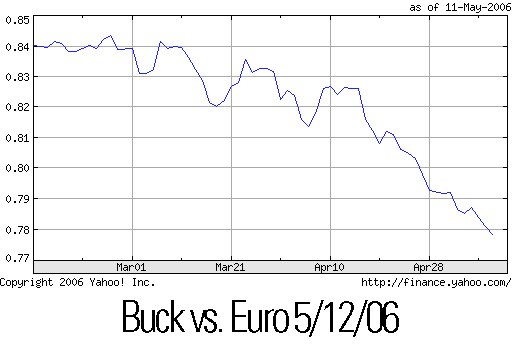
In July Iran will ditch the dollar in favour of the euro as the currency in which it will accept payments for its oil and natural gas exports, Iranian president Mahmoud Ahmadinejad announced Friday.
There's been a lot of talk about this move, and some feel it's no small factor in Bush's current appalling campaign of saber-rattling against Iran.
(Saddam made noises to this effect as well.)

Anyway, the thought that this would weaken the dollar—preposterous! The buck's in GREAAAATTT shape.

WWED: What would Evo do?

Bolvian president Evo Morales is sick of taking shit from predatory mutlinational energy companies, and is doing something about it–by nationalizing Bolivian resources and vowing not to stop with that (land, he promises, is next). I wish him the best and hope he doesn't fall victim to an "accident" like so many populists before him.

This makes me wonder when will Americans start looking at things that way, and wake up to the fact that their own "resources" are being plundered?

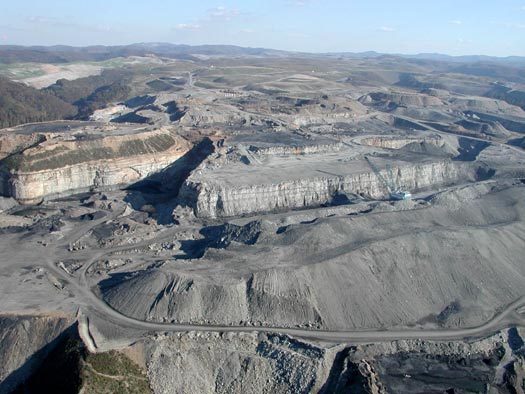
As I type, the mountaintops of Appalachia—not just Kentucky, but West Virginia and Tennessee as well—are being blown away, several ridges a week (!). Three million pounds of explosives a day! Read that number again.

Precious topsoil, a thousand years in the making, is dumped into the valleys below, all for thin veins of coal. The process is only economically feasible for predators like Massey Energy because it basically involves very few human beings. Those unpleasant labor disputes of years past no longer get in the way of pure mining profits—which of course shoot straight out of the area. Coal-area communities are left with less than nothing—blighted landscape, dangerous impoundments, polluted rivers. Maybe Evo is onto something. But when it's your own government that's raping you, to whom can you turn...?

I really have no idea. But everyone should read The Rape of Appalachia, the Michael Snayerson essay in Vanity Fair. You might think the title is over the top, but after reading the essay I guarantee you won't. For some perspective, it never hurts to turn to the words of Wendell Berry, who wrote the great essay Compromise Hell! a few years back.
Nearly forty years ago my state of Kentucky, like other coal-producing states, began an effort to regulate strip mining. While that effort has continued, and has imposed certain requirements of "reclamation," strip mining has become steadily more destructive of the land and the land's future. We are now permitting the destruction of entire mountains and entire watersheds. No war, so far, has done such extensive or such permanent damage. If we know that coal is an exhaustible resource, whereas the forests over it are with proper use inexhaustible, and that strip mining destroys the forest virtually forever, how can we permit this destruction? If we honor at all that fragile creature the topsoil, so long in the making, so miraculously made, so indispensable to all life, how can we destroy it? If we believe, as so many of us profess to do, that the Earth is God's property and is full of His glory, how can we do harm to any part of it?
In Kentucky, as in other unfortunate states, and again at great public cost, we have allowed -- in fact we have officially encouraged -- the establishment of the confined animal-feeding industry, which exploits and abuses everything involved: the land, the people, the animals, and the consumers. If we love our country, as so many of us profess to do, how can we so desecrate it?

But the economic damage is not confined just to our farms and forests. For the sake of "job creation," in Kentucky, and in other backward states, we have lavished public money on corporations that come in and stay only so long as they can exploit people here more cheaply than elsewhere. The general purpose of the present economy is to exploit, not to foster or conserve.


Look carefully, if you doubt me, at the centers of the larger towns in virtually every part of our country. You will find that they are economically dead or dying. Good buildings that used to house needful, useful, locally owned small businesses of all kinds are now empty or have evolved into junk stores or antique shops. But look at the houses, the churches, the commercial buildings, the courthouse, and you will see that more often than not they are comely and well made. And then go look at the corporate outskirts: the chain stores, the fast-food joints, the food-and-fuel stores that no longer can be called service stations, the motels. Try to find something comely or well made there.

What is the difference? The difference is that the old town centers were built by people who were proud of their place and who realized a particular value in living there. The old buildings look good because they were built by people who respected themselves and wanted the respect of their neighbors. The corporate outskirts, on the contrary, were built by people who manifestly take no pride in the place, see no value in lives lived there, and recognize no neighbors. The only value they see in the place is the money that can be siphoned out of it to more fortunate places -- that is, to the wealthier suburbs of the larger cities.

Can we actually suppose that we are wasting, polluting, and making ugly this beautiful land for the sake of patriotism and the love of God? Perhaps some of us would like to think so, but in fact this destruction is taking place because we have allowed ourselves to believe, and to live, a mated pair of economic lies: that nothing has a value that is not assigned to it by the market; and that the economic life of our communities can safely be handed over to the great corporations.

Read the whole essay...

Also, here's a good look at the ABCs of mountaintop removal.

Wednesday, May 10, 2006

Surprising, definitely surprising

From A Tiny Revolution comes the revelation that Douglas Feith, now pulling down a fat stipend for sharing his lunatic ideas with Georgetown students (the press release calls him a "Distinguished Practitioner in National Security Policy"—wipe the tears of laughter from your eyes), had a novel idea for "our" post-911 "response":

Until today I'd never heard of this special Douglas Feith plan after September 11th:

Days after 9/11, a senior Pentagon official lamented the lack of good targets in Afghanistan and proposed instead U.S. military attacks in South America or Southeast Asia as "a surprise to the terrorists," according to a footnote in the recent 9/11 Commission Report. The unsigned top-secret memo, which the panel's report said appears to have been written by Defense Under Secretary Douglas Feith, is one of several Pentagon documents uncovered by the commission which advance unorthodox ideas for the war on terror. The memo suggested "hitting targets outside the Middle East in the initial offensive"...

Specifically, Feith wanted to bomb the “triple border region” where Paraguay, Argentina and Brazil meet. I think one thing's for sure: that would have been "a surprise." And, not just for Osama bin Laden.

Moreover, if the criteria was just that our response be violent and "a surprise to the terrorists," attacking South America is thinking kind of small. Here's what I would have suggested:

• assassinate the Dalai Lama
• blow up the moon
• have the entire Bush cabinet dress up as Carmen Miranda and then, on national television, commit hara-kari

I hope you might have some ideas of your own.

Check the "comments" section. There are some good ones....

Honestly, bombing Afghanistan to smithereens made only marginally more sense but mainstream opinion hardly blinked at the idea. I think of Jon Stewart sucking up to Colin Powell on his show—"Because right after 9/11, the Afghanistan war — man did I dig that. I’d like to go again....."

Monday, May 08, 2006

Another sad obit

This one totally out of the blue. The great Australian singer-songwriter Grant McLennan died Saturday in his sleep in Brisbane. He was 48.

I first came upon the Go-Betweens on a lengthy visit to Australia in I think 1985 or 1986. I first listened to "Cattle and Cane," perhaps his greatest song, on a cassette tape in a little Toyota driving across the very Queensland landscapes the song described. Which I thought was cool.

I saw the Go-Betweens play at the Tivoli Ballroom in Sydney that year, and they were rock stars. The show was rowdy, and the crowd absolutely adored them.

A couple years later I caught the band in New York, at one of those clubs uptown in the west 50s that hasn't had gigs for years. That show had a completely different vibe. Quiet, respectful, still adoring.

The two of them, McLennan and Robert Forster, had what seemed to me this just-successful-enough musical career. They maintained this perfect bohemian thing. Never celebrities, but always artists. Sweet spot. I may be wrong about that. They may have had serious money worries, or their families maybe kept pestering them for years to grow up and take on a profession. Or not. I have no idea. I just know that to me they were always a sort of role model for bohemians when they grow up.

I remember the summer of 1989. For whatever reasons my buddy Dave and I, both of us somewhat drifting transplants from the Midwest in those days, biked up from Brooklyn to Central Park pretty much every weekday, and I always packed my roommate's little yellow cassette player in my messenger bag. Every afternoon one of us would bike to the edge of the park to call our temp agency, Laury Girls, to see if there was any work coming up. There never was, pretty much for that entire summer. So we would buy Bud tall boys from the itinerant beer salesmen in the Sheep's Meadow, throw a frisbee around, and listen to Sixteen Lovers Lane. I can't remember even bringing another tape along. It was the soundtrack of that summer for me, and of virtually every summer after that. My wife and I have never stoppped listening to McLennan's and Forster's solo work and all the Go-Betweens albums.

Yesterday, before we got word of McLennan's death, we were impressed that our five-year-old son kept requesting the Go-Betweens in the car. That kid knows his music.


Friday, April 28, 2006

Goodbye Bonnie


Bonnie Owens died this week, about a month after the death of her first husband, Buck Owens.

There was a period of about five years when I was living in New York and going to see every Merle Haggard show at what was then Tramps. Some of the shows were a little perfunctory, but the best of them were among my favorite music memories ever. As far as I can remember, Bonnie opened and sang backup for every one of these shows.

I have always wondered about the oddness of Haggard's decision to have a three-wives-ago ex accompany him on tour. But the relationship endured for whatever reasons. When a friend of Bonnie's calls her "kind of the glue for both these guys" (meaning Haggard and Owens), it seems like more than the typical platitude.

The L.A. Times obituary mentions the outlines of an American life—sometimes glorious, sometimes hard-bitten. Bonnie Owens was born into a sharecropping family ... moved from Oklahoma to Arizona when 12 ... met Buck Owens at a roller-rink ... married to him at 18 ... waitress at the legendary Blackboard who wrote song lyrics on cocktail napkins ... meets Haggard at 21 ... marries Hag ... named the 1967 ACM best female vocalist ... divorce ... then the lifetime supporting role, singing backup and "washin' and ironin' and pickin' up"—always, it seemed, with consummate good cheer.

Laura Cantrell's song "Queen of the coast," is a respectful but sometimes sharp, and pretty heartbreaking look at Owens' life, especially her decision to "drop the torch of her own career to stoke mine," as Haggard describes it.
She was the Queen of the Coast back in nineteen sixty five,
Prettier 'n most, she could keep a room alive,
With the catch in her voice and the beehive on her head.
Do you remember anything she ever said.

Well, some stars fade faster than the rest,
And the promise wore off though she did her best.
She finally looked around for somethin' else to do.
What she found was a man who needed what she knew.

Have you forgotten? Have you forgiven?
Tell me are you livin' just a little in your past every day.
Time sure has changed you; it's walked right on by you.
Does it satisfy you to have so little to say?

For the next ten years she rode around on the bus.
She did washin' and ironin' and pickin' up.
She had a place to stand at the back of the stage.
She was there every night, lookin' her age.

She lent her voice, but she gave her heart.
And, I guess, that must've been the hardest part.
She figured out exactly what was goin' on,
All the love she had given for a song.

Then things unravelled like they usually do.
She got her old heart busted up by husband, number two.

Have you forgotten? Have you forgiven?
Tell me are you livin' just a little in your past every day.
Time sure has changed you; it's walked right on by you.
Does it satisfy you to have so little to say?

I'm not quite sure when she got back on the bus.
But she's still washin' and ironin' and pickin' up.
If you look all the way to the back of the stage,
She's standin' at her mic, lookin' her age.

In a roadstop in Reno at supper time,
The waitress comes over with a look in her eye.
Says: "I saw you in Modesto almost thirty years ago,
"An' I can still remember every song in your show."

"Please Help Me, I'm Falling." "Don't Come Home A-Drinking."
Well, there's a pair of swingin' doors for every cowboy sweetheart tonight.
Time sure has changed you; it's walked right on by you.
Does it satisfy you to have so little to say?
RIP.

Tuesday, April 18, 2006

Brave Local Citizens 1, Police State 0

Let's hope that this is the beginning of more reports of local people organizing to fight the Patriot Act's most odious provisions—and winning. It's a small victory, I know. Library Connection simply won the right to declare that the FBI had come snooping. Apparently, they still have to submit to the snooping.

After fighting ferociously for months, federal prosecutors relented yesterday and agreed to allow a Connecticut library group to identify itself as the recipient of a secret F.B.I. demand for records in a counterterrorism investigation.

The decision ended a dispute over whether the broad provisions for secrecy in the USA Patriot Act, the antiterror law, trumped the free speech rights of library officials. The librarians had gone to federal court to gain permission to identify themselves as the recipients of the secret subpoena, known as a national security letter, ordering them to turn over patron records and e-mail messages.

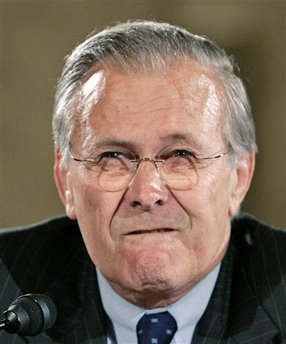
Rummy: sweatin' the details of torture


I admit to suffering from what the Onion pegged, quite brilliantly, as outrage fatigue (in 2004, oh so many outrages ago).

Still, once in a while a piece of news comes along that says, "as bad as you thought things were, they're so much worse. You have NO idea."

So: Rumsfeld. Personally. Supervising. Torture.
Human Rights Watch says it believes U.S. Defense Secretary Donald Rumsfeld could be criminally liable for the torture of a detainee at Guantanamo Bay in late 2002 and 2003.

The universally respected international organization was commenting on an Army Inspector General's report which contains a sworn statement by Lt. Gen. Randall M. Schmidt that implicates Secretary Rumsfeld.

The report, obtained by Salon.com, was based on an investigation that was carried out in early 2005, and included two interviews with Rumsfeld. In the report Gen. Schmidt describes the defense secretary as being "personally involved" in the interrogation of detainee Mohammad al-Qahtani....

"The question at this point is not whether Secretary Rumsfeld should resign, it's whether he should be indicted," said Joanne Mariner, Terrorism and Counterterrorism Program director at Human Rights Watch. "General Schmidt's sworn statement suggests that Rumsfeld may have been perfectly aware of the abuses inflicted on al-Qahtani."

Tuesday, April 11, 2006

More upside-down Christianity


How can we be practice Christianity if we can't call gays faggots and tell 'em they're gonna burn in hell?


I could post a dozen stories a day on this theme. Usually, my sentiment is why bother? But I just had to share this one from the L.A. Times today:
Ruth Malhotra went to court last month for the right to be intolerant.

Malhotra says her Christian faith compels her to speak out against homosexuality. But the Georgia Institute of Technology, where she's a senior, bans speech that puts down others because of their sexual orientation.

Malhotra sees that as an unacceptable infringement on her right to religious expression. So she's demanding that Georgia Tech revoke its tolerance policy.

With her lawsuit, the 22-year-old student joins a growing campaign to force public schools, state colleges and private workplaces to eliminate policies protecting gays and lesbians from harassment. The religious right aims to overturn a broad range of common tolerance programs: diversity training that promotes acceptance of gays and lesbians, speech codes that ban harsh words against homosexuality, anti-discrimination policies that require college clubs to open their membership to all.

The Rev. Rick Scarborough, a leading evangelical, frames the movement as the civil rights struggle of the 21st century. "Christians," he said, "are going to have to take a stand for the right to be Christian.
See also The Abominable Shellfish: Why some Christians hate gays but love bacon.

Wednesday, April 05, 2006

That pinko rag the Times


I just don't get what makes wingnuts see red when they read The New York Times. Or do they even read it? A left-wing publication? Now where do they get that shit?

The Pentagon Papers. OK. Yeah. But that was a long time ago.

These days, how does one tell the difference between where the Times and Bush stand when it comes to countries Dubya wants to lean on?

Not a day goes by without some bizarrely, decontextualized slanted news article or editorial warning of ominous Iranian aggression, Syrian "crackdowns," or a recent favorite—Venezuela's nefarious, gasp, spreading of money around to poor people in other countries.

I'm trying mentally to recreate the process of writing a Times article on Mr. Chavez. (Even he is entitled to the honorific in the Times. Nice, genteel archaiac touch. Very NYT.) The editor and writer consult. They ponder. Hmm. Story on Venezuela.... Well, we need some perspective. Let's call up The Heritage Foundation for a quote! (Gee, wonder what they'll say.) Or how about Mr. Death Squads himself, John Negroponte, who whines that "Mr. Chávez is 'spending considerable sums involving himself in the political and economic life of other countries in Latin America and elsewhere, this despite the very real economic development and social needs of his own country.'"

As an observant letter writer noted today, Negroponte's "exact words could be used to describe the Bush approach.... Perhaps if we spent our foreign aid on popular programs that aided the poor rather than military invasions, we would be received with the enthusiasm that Mr. Chávez is enjoying." (And that may be an understatement: Hugo's approval numbers are at nearly 83 per cent).

Meanwhile, as the indefatigable Mr. Chomsky points out elsewhere, when it comes to the crimes of its own country's politicians and military leaders, The Times casts a blind, even approving eye on such things as clear violations of Geneva Protocols:

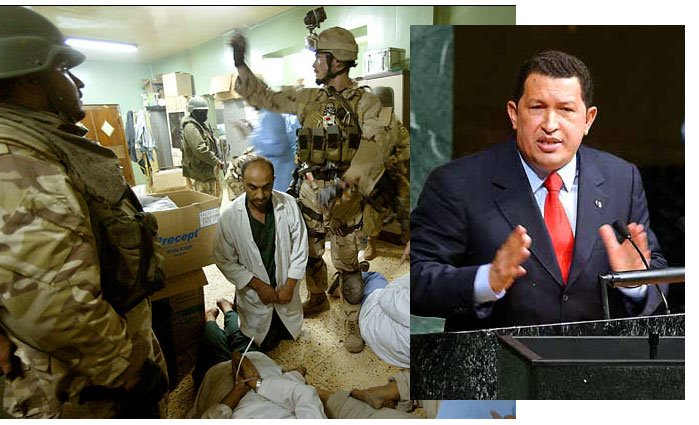
After several weeks of bombing, the United States began its ground attack in Falluja. It opened with the conquest of the Falluja General Hospital. The front-page story in the New York Times reported that "patients and hospital employees were rushed out of rooms by armed soldiers and ordered to sit or lie on the floor while troops tied their hands behind their backs." An accompanying photograph depicted the scene. It was presented as a meritorious achievement. "The offensive also shut down what officers said was a propaganda weapon for the militants: Falluja General Hospital, with its stream of reports of civilian casualties." Plainly such a propaganda weapon is a legitimate target, particularly when "inflated civilian casualty figures" -- inflated because our leader so declared -- had "inflamed opinion throughout the country, driving up the political costs of the conflict...."

Some relevant documents passed unmentioned, perhaps because they too are considered quaint and obsolete: for example, the provision of the Geneva Conventions stating that "fixed establishments and mobile medical units of the Medical Service may in no circumstances be attacked, but shall at all times be respected and protected by the Parties to the conflict." Thus the front page of the world's leading newspaper was cheerfully depicting war crimes for which the political leadership could be sentenced to severe penalties under U.S. law, the death penalty if patients ripped from their beds and manacled on the floor happened to die as a result. The questions did not merit detectable inquiry or reflection. The same mainstream sources told us that the U.S. military "achieved nearly all their objectives well ahead of schedule," as "much of the city lay in smoking ruins."

As if...

Chomsky at his biting best, in an excerpt from his new book, Failed States, The Abuse of Power and the Assault on Democracy. This excerpt examines the atrocity of the Fallujah assault, media complicity and silence in the face of a systemic pattern of war crimes, and public ignorance and/or apathy in the face of the facts (past and present).

The Lancet study estimating 100,000 probable deaths by October 2004 elicited enough comment in England that the government had to issue an embarrassing denial, but in the United States virtual silence prevailed. The occasional oblique reference usually describes it as the "controversial" report that "as many as 100,000" Iraqis died as a result of the invasion. The figure of 100,000 was the most probable estimate, on conservative assumptions; it would be at least as accurate to describe it as the report that "as few as 100,000" died. Though the report was released at the height of the U.S. presidential campaign, it appears that neither of the leading candidates was ever publicly questioned about it.

The reaction follows the general pattern when massive atrocities are perpetrated by the wrong agent. A striking example is the Indochina wars. In the only poll (to my knowledge) in which people were asked to estimate the number of Vietnamese deaths, the mean estimate was 100,000, about 5% of the official figure; the actual toll is unknown, and of no more interest than the also unknown toll of casualties of U.S. chemical warfare. The authors of the study comment that it is as if college students in Germany estimated Holocaust deaths at 300,000, in which case we might conclude that there are some problems in Germany -- and if Germany ruled the world, some rather more serious problems.

Tuesday, March 21, 2006

Wal-mart: the white knight of the organic food business?

There's an interesting piece by Field Maloney, a New Yorker staffer, on "the dark secrets of the organic food movement" in Slate that makes many good points but ends with the batshit insane suggestion that Wal-mart's entry into the organic food biz might be a good thing.

There's no guarantee that a consumer is doing the right thing simply by buying a product labeled "organic." Big producers have watered down the label, for one thing, and as Maloney explains:
When the Department of Agriculture established the guidelines for organic food in 1990, it blew a huge opportunity. The USDA—under heavy agribusiness lobbying—adopted an abstract set of restrictions for organic agriculture and left "local" out of the formula. What passes for organic farming today has strayed far from what the shaggy utopians who got the movement going back in the '60s and '70s had in mind. But if these pioneers dreamed of revolutionizing the nation's food supply, they surely didn't intend for organic to become a luxury item, a high-end lifestyle choice.
Absolutely right. Eating out-of-season organic tomatoes from Chile or California in New York is probably worse for the environment than eating New Jersey tomatoes that lack the organic label.

But Maloney wanders onto much shakier ground when he goes on to suggest that:
It's likely that neither Wal-Mart nor Whole Foods will do much to encourage local agriculture or small farming, but in an odd twist, Wal-Mart, with its simple "More for Less" credo, might do far more to democratize the nation's food supply than Whole Foods. The organic-food movement is in danger of exacerbating the growing gap between rich and poor in this country by contributing to a two-tiered national food supply, with healthy food for the rich. Could Wal-Mart's populist strategy prove to be more "sustainable" than Whole Foods? Stranger things have happened.
Really? I'd like to know what would be stranger than that.

I won't argue that anti-Wal Mart prejudice doesn't contain some elements of snobbery, or that eating organic can be simply one more status symbol for wealthy consumers. But it's a ridiculous argument that to say that Wal-mart will somehow "democratize" the organic food business. Wal-mart's history of how it treats its workers and suppliers and local communities is there for all to see. A recent U.C. Berkeley study concluded that Wal-Mart "actually reduced the take-home pay of retail workers by $4.7 BILLION dollars annually." What organic farmer who desires to make a good living is eager to deal with that company?

And there's no small irony to the juxtaposition of this story with Why the nation's largest community garden must become a Wal-mart warehouse. Tom Philpott argues that the heartbreaking battle over Los Angeles' South Central Community Garden is a microcosmic illustration of the essential contradiction between community sustainability and the inexorable logic of global trade (of which Wal-mart is certainly one of the prime movers).

Down the road, food should be organic AND locally grown. That's the basic argument for real "homeland security." Whole Foods, while it has its shortcomings, is probably somewhat approachable on the latter issue.
Can a leopard change its spots? Anything's possible. But based on its track record with employees and providers, having Wal-mart dominating the organic food market is an idea that almost too awful to contemplate.

Here is the Organic Consumer Association's manifesto for "breaking the chains":
The answer to Wal-Martization and so-called “Free Trade” is ethical consumer purchasing and political action--building and supporting local and community-based producers and businesses through solidarity, collective purchasing power, and mutual aid. Fair Trade, not Free Trade, must become the global norm, with organic and sustainable production leading the way. Local and community control over essential goods and services provides the only solid foundation for economic democracy, a sustainable environment, and public health.

Monday, March 20, 2006

"Free fraud zone"


A documentary scheduled to run on the UK's Channel4 tonight will look at the scandal of Iraq's missing billions—huge amounts of cash, earmarked for Iraqi reconstruction, but either stolen outright by American contractors or doled out on now-familiar Bush-regime lines of loyalty.

"[R]ather than being a technical agenda, I believe it was largely a politically motivated reward-and-punishment kind of agenda," said Mary Patterson, an experienced health worker who was eventually asked to leave Iraq by James Haveman, the man appointed by the Pentagon to supervise the reconstruction of the Iraqi health service.

Haveman, who had zero experience in international health work, was however highly qualified to work for the Bush regime, with his track record of being "a loyal Bush supporter, who had campaigned for Jeb Bush, and a committed evangelical Christian."

Another plugged-in contracting company, Custer Battles, billed the U.S. government for $10 million dollars in return for $3 million of actual expenditure. "Perhaps more remarkable is that the US government, once it knew about the scam, took no legal action to recover the money."
When the coalition troops arrived in Iraq, they were received with remarkable goodwill by significant sections of the population. The coalition had control up to a point and, perhaps more importantly, it had the money to consolidate that goodwill by rebuilding Iraq, or at least make a significant start.

Best of all for the US and its allies, the money came from the Iraqis themselves.
Because the Iraqi banking system was in tatters, the funds were placed in an account with the Federal Reserve in New York. From there, most of the money was flown in cash to Baghdad.

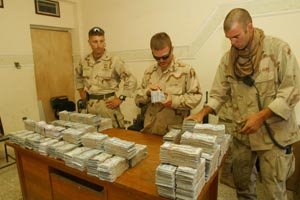
Over the first 14 months of the occupation, 363 tonnes of new $100 bills were shipped in - $12bn, in cash. And that is where it all began to go wrong.
"Iraq was awash in cash - in dollar bills. Piles and piles of money," says Frank Willis, a former senior official with the governing Coalition Provisional Authority. "We played football with some of the bricks of $100 bills before delivery. It was a wild-west crazy atmosphere, the likes of which none of us had ever experienced."

The environment created by the coalition positively encouraged corruption. "American law was suspended, Iraqi law was suspended, and Iraq basically became a free fraud zone," says Alan Grayson, a Florida-based attorney who represents whistleblowers now trying to expose the corruption. "In a free fire zone you can shoot at anybody you want. In a free fraud zone you can steal anything you like. And that was what they did."

Read the whole article...

It's rather important to remember that this was Iraqi money that was stolen. At the start of America's atack on Iraq, "around $23bn-worth of Iraqi money was placed in the trusteeship of the US-led coalition by the UN. The money, known as the Development Fund for Iraq and consisting of the proceeds of oil sales, frozen Iraqi bank accounts and seized Iraqi assets, was to be used in a 'transparent manner,' specified the UN, for 'purposes benefiting the people of Iraq.'"

Friday, March 17, 2006

Of magical places and iron fists


Tom Philpott, a financial writer turned farmer (which is sort of the path I'm on, albeit at a much earlier stage), is always worth reading.

While he appears to have at least temporarily abandoned his great, cleverly named Bitter Greens Journal blog, which he describes as "a running critique of industrial agriculture, a clearinghouse for info on sustainable farming, and a working manifesto for a liberation politics based on food," his writing continues to appear in other venues.

He seems primarily to focus on contributions to Grist and Gristmill (here's a recent piece), but today he turns up in Counterpunch, with a heartbreaking, sharply reasoned look at the tragedy of Los Angeles' South Central Community Farm, the nation's largest community garden, which, it appears, is being done in by the double whammy of dubious backroom real estate deals and the "invisible fist of neoliberalism," which has come down hard on the (mostly Central American, all poor) plot holders. Taking land nobody wanted at the time, these 325 families have created what the L.A. Times allows is a "special, almost magical place." Of course the Times, its priorities always in place, doesn't allow itself to get carried away: "no magic is so strong that it erases a landowner's right to either his property or its fair value."

As Philpott explains, that "right" and "fair value" are not exactly clear cut.
Irony abounds here like vegetables in a well-tended garden plot. Most of the plot holders are immigrants from Mexico and Central America. A generation of neoliberal policies in Latin America has turned smallholder farming there into an economic disaster, sending legions of displaced farmers north in search of gainful employment. These immigrants-whose hard work for low pay has helped underwrite the U.S. inflation miracle, keeping interest rates low so consumers can, well, consume-find few opportunities to grow their own food here in El Norte. In this case, when they did gain access to kitchen plots, the invisible fist of neoliberalism swooped down again, powered as always by property's inalienable right.

Yet the ironies go deeper than double-displacement-deeper even than plunking a big-box warehouse, groaning with goods manufactured by low-wage workers in China, on top of a food source for low-wage Latino workers in the United States. To understand fully the brazenness of Horowitz's power play-and the feebleness of the Times' response to it-you have to sift through the details of how the developer gained title to the land.

Earth to Congress: WTF?

The disconnect between constituents and their representative is truly shocking. Congress no longer even pays lip service to the idea of speaking for the people they work for.

While the citizens are rarin' to go forward with censure and impeachment proceedings, only one—one!—senator has aligned himself with Feingold's call to censure Bush.

From Raw Story:

A new poll finds that a plurality of Americans favor plans to censure President George W. Bush, while a surprising 42% favor moves to actually impeach the President.

A poll taken March 15, 2006 by American Research Group found that among all adults, 46% favor Senator Russ Feingold's (D-WI) plan to censure President George W. Bush, while just 44% are opposed. Approval of the plan grows slightly when the sample is narrowed to voters, up to 48% in favor of the Senate censuring the sitting president.

Even more shocking is that just 57% of Republicans are opposed to the move, with 14% still undecided and 29% actually in favor. Fully 70% of Democrats want to see Bush censured.

More surprising still: The poll found fully 43% of voters in favor of actually impeaching the President, with just 50% of voters opposed. While only 18% of Republicans surveyed wanted to see Bush impeached, 61% of Democrats and 47% of Independents reported they wanted to see the House move ahead with the Conyers (D-MI) resolution.

And what does the opposition party have to say?
Democrats have to focus on average voters and their needs and not get diverted by other things," said Sen. Charles Schumer of New York, who leads the Democratic Senatorial Campaign Committee. "That's where we'll find success."

When asked about the censure resolution, Rep. Rahm Emanuel of Illinois, chairman of the Democratic Congressional Campaign Committee, paused for several seconds before wrinkling his face and trying to change the subject. He and others believe the censure discussion is a distraction.

A full 46% of citizens, a plurality, want to censure the president. A mere 2% of senators are behind the move. What does that tell you?

Even Sandra Day O'Connor (who, it might be said, bears no little responsibilty for installing the current regime), is talking dictatorship. And the democrats call the censure move a "distraction."

Really, who do these guys work for?

Today on Huffington Post, Cenk Uygur has a pretty funny piece on the subject called Three Crazy Things Democratic Politicians Believe.

Thursday, March 16, 2006

Common sense—who could argue?

Not that you'd know about it, but Reps. Lynne Woolsey and Barbara Lee introduced the modest and realistic Common Sense Budget Plan last week.

The plan calls for $60 billion in cuts for the Pentagon (from total military spending of about $1.1 trillion), all of which will come from obsolete programs, as identified by a team led by Lawrence Korb, Reagan's assistant secretary of defense for Manpower, Installation and Logistics.

According to the San Francisco Chronicle:
Backers have a wish list for spending the proposed $60 billion in defense savings: $5 billion to homeland security improvements, including a program to inspect all 11 million shipping containers that enter the country annually; $10 billion to move toward energy independence; $10 billion for children's health care; $10 billion for school construction; $5 billion for job training; $2 billion for medical research; and $13 billion for overseas humanitarian aid. Another $5 billion would go to start cutting the rising national debt.

The proposal, Lee said, would "slash $60 billion from the defense budget without diminishing our ability to protect our nation.''
Sounds greeaaaattt, right? Who could be against such a bill? Would it surprise you to learn that "there's little chance Republican House leaders will allow a committee or a floor vote on the plan."

Business Leaders for Sensible Priorities, a group whose leaders include Ben Cohen Ben and Jerry's fame, are buying ads in Iowa and New Hampshire to boost the idea of the $60 billion cut in Pentagon spending.

"We know once the people there see how this money is spent, they will come to conclude on their own that it's right,'' Cohen said of the proposed cut.

"Oh, it was breathtaking!"

Victims of U.S. raid yesterday (AP)

On the third anniversary of the start of something big (we still don't know what exactly), FAIR remembers the glory of the war that "united the country and brought the military back" (according to Newsweek's Howard Fineman)....
"Oh, it was breathtaking. I mean I was almost starting to think that we had become inured to everything that we'd seen of this war over the past three weeks; all this sort of saturation. And finally, when we saw that it was such a just true, genuine expression. It was reminiscent, I think, of the fall of the Berlin Wall. And just sort of that pure emotional expression, not choreographed, not stage-managed, the way so many things these days seem to be. Really breathtaking."
Washington Post reporter Ceci Connolly, appearing on Fox News Channel on 4/9/03, discussing the pulling down of a Saddam Hussein statue in Baghdad, an event later revealed to have been a U.S. military PSYOPS operation [stunt]--Los Angeles Times, 7/3/04


"Picture perfect. Part Spider-Man, part Tom Cruise, part Ronald Reagan. The president seizes the moment on an aircraft carrier in the Pacific."
PBS's Gwen Ifill, 5/2/03, on George W. Bush's "Mission Accomplished" speech)


"Well, the hot story of the week is victory.... The Tommy Franks-Don Rumsfeld battle plan, war plan, worked brilliantly, a three-week war with mercifully few American deaths or Iraqi civilian deaths.... There is a lot of work yet to do, but all the naysayers have been humiliated so far.... The final word on this is, hooray."
Fox News Channel's Morton Kondracke, 4/12/03

Molly, en fuego

Oh, Molly. You're on a roll. She spoke for many millions last week when she wrote in the Progressive, "I have had it with the D.C. Democrats, had it with the DLC Democrats, had it with every calculating, equivocating, triangulating, straddling, hair-splitting son of a bitch up there" and that she "can’t see a damn soul in D.C. except Russ Feingold who is even worth considering for President. The rest of them seem to me so poisonously in hock to this system of legalized bribery they can’t even see straight."

Today, she takes on "the long war" we're being force-fed, and the return of a certain Republican eminence who left the public eye a clown, and now returns as ... still, a clown:

As of Sept. 11, 2001, there were a few hundred people identified with al-Qaida’s ideology. Even then, it was unclear the American military was the right tool for the job. Now, Rumsfeld is apparently prepared to put the full might of the U.S. military into this fight indefinitely, backed by the full panoply of ever-more expensive weapons and the whole hoorah. I don’t think the people who got us into Iraq should be allowed to do this because, based on the evidence of Iraq, I don’t think they have the sense God gave a duck.

On top of everything else, Rumsfeld is now circulating a grand strategy for the Long War written by Newt Gingrich. Am I the only person covering politics who ever noticed that Newt Gingrich is actually a nincompoop? When Newt bestrode the political world like a colossus (Time magazine’s Man of the Year in 1995), many people took him seriously—but he was a fool then, too. The Republicans were so thrilled to have someone on their side who had ideas, they never seemed to notice Newt’s were drivel.

From orphanages to space colonies, it was all shallow but endearingly enthusiastic futurism. Gingrich was the kind of person who read a book or two on something and would then be quite afire as to how this was going to fit into some shining future. Republicans are so amnesiac, they didn’t even snicker when Newt turned up recently posing as a respected party elder to give them advice on ethics. Ethics. Next, family values.

I have no idea whom this administration plans to talk into its Long War, but I’m sure they won’t roll out the new campaign in August. In order to sell this, they’ll have to scare us, assuming some obliging terrorists don’t do it for them.

I came across this quote in a recent obituary for George Gerbner, who headed the Annenberg School for Communication for 25 years: “Fearful people are more dependent, more easily manipulated and controlled, more susceptible to deceptively simple, strong, tough measures and hard-line postures. ... They may accept and even welcome repression if it promises to relieve their insecurities.”

Which of course brings to mind Ben Franklin's (and/or Jefferson's) apercu, more relevant than ever 200-something years later: "people willing to trade their freedom for temporary security deserve neither and will lose both."

Wednesday, March 15, 2006

The practice war

I know George Bush has stolen the car, but you might say the car was running, the door was open, and the keys were left in the ignition by his predecessors.

Counterpunch takes the occasion of Milosevic's murky death to revisit those heady days of "the liberals' war"—when self-identified progressives discovered the frisson that comes with getting behind blowing women and children up with bombs from on high.

The opening paragraph of a March 6, 1999 Cockburn piece is a classic:
Strange are the ways of men! It feels like only yesterday that the New York Times was denouncing President Bill as a moral midget, deserving of the harshest reprobation for fondling Monica Lewinsky's breasts. And today here's the New York Times doling out measured praise to the same president for blowing little children in pieces. The Times last Thursday had pictures of those dead refugees on its cover, bombed by one of NATO's aviators. Editorial page editor Howell Raines staked out the Times official view that "For now, NATO must sustain and intensify the bombing." What a weird guy Raines must be. Kiss Monica's tits and he goes crazy. Bomb peasants and he shouts for more.
Some of this lookback doesn't age all that well. "Leftist opponents of the war, such as ourselves [writes Cockburn] now march shoulder to shoulder with Chuck Colson, Barry Farber, Don Feder, Bob Grant, Bob Novak, Arriana Huffington, A.M. Rosenthal, Charles Krauthammer, Edward Luttwak, Oliver North, Joe Sobran and the Pope."

That was the other Pope, the dead one, who described NATO's bombing as an "act of diabolical retribution." Cockburn can still be pals with some of the guys he mentions, but not all. Is it safe to say some of those characters were antiwar simply out of of party loyalty/anti-Clinton prejudice? But here's to Counterpunch's celebration of "heartening evidence of interesting coalitions"—something that goes on to this day—and for its unceasing exposure of frauds.

This scene ends badly, as you might imagine. Anything sound familiar here?
So the NATO bombs began to fall and, exactly as could have been predicted, the Serbian brutalities in Kosovo escalated and the tidal wave of refugees began. Everything has gone according the script. NATO bombs destroying Serbian civilian infrastructure: power plants, sewage treatment, electricity and gas and oil supplies. Everything that's hit is hastily described by NATO spokesmen as "dual purpose," (i.e., possibly also for Serb military use) unless it's obvious to all that only peasants, with no conceivable "dual purposes" have been blasted to bits. Wednesday last saw the mad NATO supreme commander, Wesley Clark, utter his most deliberate and obvious lie to date, when he said that "There was a military convoy and a refugee convoy. We struck the Serb convoy and we have very strong evidence that the Serbs then retaliated by attacking the column of refugees." By the next day it became clear that there was no "Serb convoy," no "very strong evidence" and that an Albanian column of refugees on tractors had been killed by NATO bombers.
And three years later, the demonize-and-bomb (but only as "a last option") scam worked to perfection in another venue. Except, uh, the bombs are still falling....

Juan on Iran

Juan Cole's Fishing for a Pretext to Squeeze Iran is a necessary inoculation of reason against the relentless framing of Iran as a rogue nation:
The Nuclear Non-Proliferation Treaty allows Iran to develop civilian nuclear energy, and the United States itself urged Iran to build reactors in the 1970s. Iran does not have a heavy-water breeder reactor, which is the easy way to get a bomb. It does have light-water reactors for energy production, but these cannot be used to get enough fissionable material to make a bomb. Although Vice President Dick Cheney has made light of an oil state seeking nuclear energy, it would be a rational economic policy to use nuclear energy for domestic needs and sell petroleum on the world market. Certainly, the NPT permits such a policy.

The difficulty for those concerned with proliferation is that for Iran to independently run its light-water reactors, it needs to complete the fuel cycle of uranium enrichment. The ability to produce nuclear fuel is only one step away from the ability to refine uranium further, to weapons-grade quality. Still, it is a step away and could not easily be done in secret with inspectors making visits. Iran is experimenting with refrigerator-size centrifuges as a means of enriching uranium, but would need 16,000, hooked up in a special way, to produce a bomb. It has 164, and one of its proposals to defuse the crisis with the U.S. is to limit itself to no more than 3,000. Otherwise, it says it ideally would have 50,000 centrifuges.

No signatory of the NPT that allows regular IAEA inspections has ever moved to the stage of bomb production. Inspections have been extremely effective tools. United Nations weapons inspectors discovered and dismantled Saddam Hussein’s weapons program after the Gulf War in the early 1990s. The IAEA was even able to detect trace plutonium on Iranian equipment that came from Pakistan, which manufactures bombs. Those who remain suspicious of Iran’s ultimate intentions are not completely without a case. But there is good reason to believe that Iran’s nuclear program could have been monitored successfully.

The Bush administration has arbitrarily taken the position that Iran may not have a nuclear research program at all, even a civilian one. This stance actually contradicts the guarantees of the Nuclear Non-Proliferation Treaty. Washington officials continually intimate to the press that Tehran has an active weapons program, which is speculation. And, of course, the United States itself is egregiously in violation of several articles of the NPT, keeping enough nuclear weapons on hair-trigger alert to destroy the world several times over and actively pursuing new and deadly weapons, even dreaming of “tactical” nukes. Its ally in the region, Israel, never signed the NPT and was helped by the British to get a bomb in the 1960s.

The U.S. National Intelligence Estimate released in summer 2005 estimates that if Iran did have an active nuclear weapons program, and if the international atmosphere were favorable to it being able to get hold of the requisite equipment, it would still be a good 10 years away from a bomb. But the international atmosphere is actively hostile to such a development, and anyway it has not been proved that there is such a weapons program.

If the Supreme Jurisprudent of theocratic Iran has given a fatwa against nukes, if the president of the country has renounced them and called for others to do so, if the International Atomic Energy Agency has found no evidence of a military nuclear weapons program, and if Iran is at least 10 years from having a bomb even if it is trying to get one, then why is there a diplomatic crisis around this issue between the United States and Iran in 2006?

The answer is that the Iranian nuclear issue is déjà vu all over again.

Tuesday, March 14, 2006

Taking the brakes off the spread of viruses

The mainstream media, always in love with the idea of a big scare, are helping to feed bird flu hysteria.

Not to overlook the fact that H5N1 the potential to mutate into something horrible, but the consequences of overselling the threat could also be—in fact have already been—disastrous. If the solution continues to be destroying and prohibiting small-scale free-ranging flocks of chickens, it could be a calamity for the world's poor who depend on their chickens, and for all of us, who stand to be driven even further into dependence on an appalling and unhealthy factory chicken-producing system.

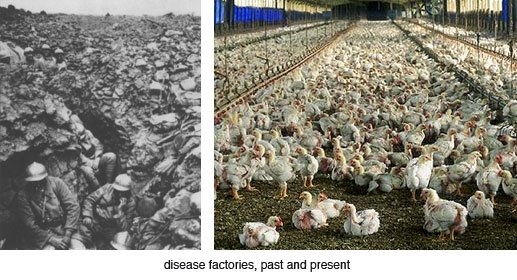
Wendy Orent, author of Plague, has been a voice of reason on this topic. First, as she pointed out a couple of weeks ago, the idea of Bird Flu having the potential to mutate suddenly, naturally, into something like the 1918 pandemic betrays an ignorance of how that flu became lethal. It took a disease factory—"the trenches, the trucks, the trains and the hospitals of World War I," according to evolutionary biologist Paul W. Ewald of the University of Louisville—to create the conditions for the virus to mutate from something harmless to something deadly. A few chickens or wild birds can't make that happen.

Writes Orent: "To think that the 1918 flu started out as a harmless intestinal bird virus that jumped directly from its wild host into human beings and immediately turned into an explosive respiratory killer is to believe that hippos fly."

It so happens that our age has its own disease factories as well as a difficult-to-regulate virus distribution network. In arguing that the price of cheap chicken is bird flu, Orent cites Earl Brown, a University of Ottawa flu virologist, who states that "lethal bird flu is entirely man-made, first evolving in commercially produced poultry in Italy in 1878. The highly pathogenic H5N1 is descended from a strain that first appeared in Scotland in 1959."
People have been living with backyard flocks of poultry since the dawn of civilization. But it wasn't until poultry production became modernized, and birds were raised in much larger numbers and concentrations, that a virulent bird flu evolved. When birds are packed close together, any brakes on virulence are off. Birds struck with a fatal illness can still easily pass the disease to others, through direct contact or through fecal matter, and lethal strains can evolve. Somehow, the virus that arose in Scotland found its way to China, where, as H5N1, it has been raging for more than a decade.

... Brown says the commercial poultry industry, which caused the catastrophe in the first place, stands to benefit most. The conglomerates will more and more dominate the poultry-rearing business. Some experts insist that will be better for us. Epidemiologist Michael Osterholm at the University of Minnesota, for instance, contends that the "single greatest risk to the amplification of the H5N1 virus, should it arrive in the U.S. through migratory birds, will be in free-range birds … often sold as a healthier food, which is a great ruse on the American public."

The truly great ruse is that industrial poultry farms are the best way to produce chickens — that Perdue Farms and Tyson Foods and Charoen Pokphand are keeping the world safe from backyard poultry and migratory birds. But what's going to be on our tables isn't the biggest problem. The real tragedy is what's happened in Asia to people who can't afford cheap, industrial chicken. And the real victims of industrially produced, lethal H5N1 have been wild birds, an ancient way of life and the poor of the Earth, for whom a backyard flock has always represented a measure of autonomy and a bulwark against starvation.

Friday, March 10, 2006

Corrupt Congress dumps local food protection

There is no other way to put it. It's all about sleaze and corruption, plain and simple. In the words of the senior Senator from my state, the most ardent defender of palm-greasing perhaps of all time, "Spending is speech." If you agree with that, you get what's coming to you.

The 283 Congressmen who voted for the National Uniformity for Food Act, H.R. 4167, have been, in the words of the Organic Consumers Association, "bought and sold." $367 million in agribusiness contributions since 1990 have finally paid off. This is a sweetheart of a deal for big ag and big food producers, and it was passed without a single public hearing.

Sponsored by Republicans, naturally, the party of "states' rights" when it suits them to strike that pose, the bill is opposed by environmental and consumer groups, as well as 39 (!) state attorneys general. It will knock 200 consumer-protecting state laws off the books and cost taxpayers an extra $100 million over the next five years (according the Congressional Budget Office).

"The House is trampling crucial health safeguards in every state without so much as a single public hearing," said Erik Olson, senior attorney for the Natural Resources Defense Council. "This just proves the old adage money talks. The food industry spared no expense to assure its passage."

A new report released Tuesday by the Natural Resources Defense Council and the Center for Science in the Public Interest, "Shredding the Food Safety Net," finds that the the proposed bill would preempt shellfish safety standard laws in at least 16 states, milk safety laws in all 50 states, and, restaurant and food service establishment safety laws in 50 states.

"The bill also targets a law limiting levels of toxic lead in candies, a law requiring warnings to consumers about excessive levels of toxic chemicals in foods that cause cancer, birth defects, or developmental problems, and laws requiring labeling of fish as farm-raised or wild," the report states. "Shredding the Food Safety Net" can be found at:
http://www.nrdc.org/legislation/factsheets/leg_06030701a.pdf.

Links


Headline of the day


From Bloomberg:
Bush's Defeat on Ports Dents Image of Competence, Exposes Republican Rifts

Wednesday, March 08, 2006

The world's oldest profession?

... well, we all know the answer to that one.

And then along came the first entrepreneur—the genius who saw that the world's first professional needed ... management and representation. The first pimp invented white-collar work.

The second oldest racket? I'd put my money on the protection shakedown.

I've recently been coming around, in sort of a nebulous way, to thinking of of the Military Industrial Complex as perhaps the most sublime iteration of the protection racket.

In an article titled "It's an Awful Lot of Money to Makes Us Less Safe and Less Free," an anonymous defense analyst named Werther takes up this Pentagon-as-protection-racket meme in in a (depressingly) cutting manner:
Let us be plain. Any organization that employs lethal force, operates in secrecy, always gets what it wants, and is unaccountable to the citizens is indistinguishable from a protection racket. And if, in return for surrendering their wallets, the citizenry is made less safe (as the more objective intelligence reports have repeatedly warned about the $300+ billion Iraq war), then some hole-in-corner reform is not going to get us anywhere.
What will it take to tame the beast? Werther offers no solutions, but states that superficial reforms ain't gonna cut it. Sadly, I agree.

Monday, March 06, 2006

Chasing the wrong chickens...

A new report by the sustainability/biodiversity-focused NGO Grain is a must-read, given the recent barrage of hysterical media coverage blaming bird flu on small-scale poultry farming.

Would it surprise anyone to learn that the main culprit in the spread of bird flu is the transnational poultry industry's factory farming techniques?

Here is the Grain press release:

Small-scale poultry farming and wild birds are being unfairly blamed for the bird flu crisis now affecting large parts of the world. A new report from GRAIN shows how the transnational poultry industry is the root of the problem and must be the focus of efforts to control the virus.

The spread of industrial poultry production and trade networks has created ideal conditions for the emergence and transmission of lethal viruses like the H5N1 strain of bird flu. Once inside densely populated factory farms, viruses can rapidly become lethal and amplify. Air thick with viral load from infected farms is carried for kilometres, while integrated trade networks spread the disease through many carriers: live birds, day-old-chicks, meat, feathers, hatching eggs, eggs, chicken manure and animal feed.

"Everyone is focused on migratory birds and backyard chickens as the problem," says Devlin Kuyek of GRAIN. "But they are not effective vectors of highly pathogenic bird flu. The virus kills them, but is unlikely to be spread by them."

For example, in Malaysia, the mortality rate from H5N1 among village chicken is only 5%, indicating that the virus has a hard time spreading among small scale chicken flocks. H5N1 outbreaks in Laos, which is surrounded by infected countries, have only occurred in the nation's few factory farms, which are supplied by Thai hatcheries. The only cases of bird flu in backyard poultry, which account for over 90% of Laos' production, occurred next to the factory farms.

"The evidence we see over and over again, from the Netherlands in 2003 to Japan in 2004 to Egypt in 2006, is that lethal bird flu breaks out in large scale industrial chicken farms and then spreads," Kuyek explains.

The Nigerian outbreak earlier this year began at a single factory farm, owned by a Cabinet minister, distant from hotspots for migratory birds but known for importing unregulated hatchable eggs. In India, local authorities say that H5N1 emerged and spread from a factory farm owned by the country's largest poultry company, Venkateshwara Hatcheries.

A burning question is why governments and international agencies, like the UN Food and Agriculture Organisation, are doing nothing to investigate how the factory farms and their byproducts, such as animal feed and manure, spread the virus. Instead, they are using the crisis as an opportunity to further industrialise the poultry sector. Initiatives are multiplying to ban outdoor poultry, squeeze out small producers and restock farms with genetically-modified chickens. The web of complicity with an industry engaged in a string of denials and cover-ups seems complete.

"Farmers are losing their livelihoods, native chickens are being wiped out and some experts say that we're on the verge of a human pandemic that could kill millions of people," Kuyek concludes. "When will governments realise that to protect poultry and people from bird flu, we need to protect them from the global poultry industry?"

Links: summary/full report

Thursday, March 02, 2006

What we want (and aren't getting)—no nukes anywhere!

On nuclear weapons, I believe people of the world have chosen abolishment, but the governments are ignoring the wishes of their people. So, we have entered the second nuclear arms race, led by current US Administration and being followed by many other countries. If our governments don't, at this point in our history, take seriously their international obligations under the Non-Proliferation Treaty (NPT) to start decommissioning all nuclear weapons, there will be a serious proliferation within the next few years and we will truly be unable to abolish nuclear weapons. We will pass a frightful legacy to our children and grandchildren, a legacy of nuclear weapons and nuclear debt that will endanger them and their world. It is not only the next generation we will burden, but the cost of nuclear weapons in the past and today has robbed the materially poor of their rightful inheritance to be nurtured with basic rights of food, education and health care.